Before answering this question, a distinction is made between Platform performance and operational results.
See the reasons behind the phenomenon: the call for no clear mandate or mandate, and often the material that cannot be commercialized or not in line with the brand. Such issues usually cross-choice, production and user decision-making, and cannot be solved by a clip or a change of title.
The Platform’s open information provides a boundary for this topic. Search-and-AI search-oriented content continues to focus on real experience, clear objects, verifiable facts and clear limits, rather than mechanically repeating keywords.
A more secure approach to landing is to provide examples without limiting creativity, to set a submission portal, to confirm in writing the scope of use and to keep the original document. Do not redo all at once; select three to five articles from the same audience for testing, to confirm the direction before expanding the series.
Validation can be divided into content and business signals. The former looks at the quality of viewing and interaction, while the latter is assessed on the basis of availability, participation costs, interaction and subsequent transformation; conclusions can only be reliable if they are explained to each other.
When you are posted to the website, you do not have to paste the original video line. The definition, applicable scenes, operating lists, common objections and source links should be supplemented, and the video that actually exists on the page should be depicted using structured data such as VideoObject.
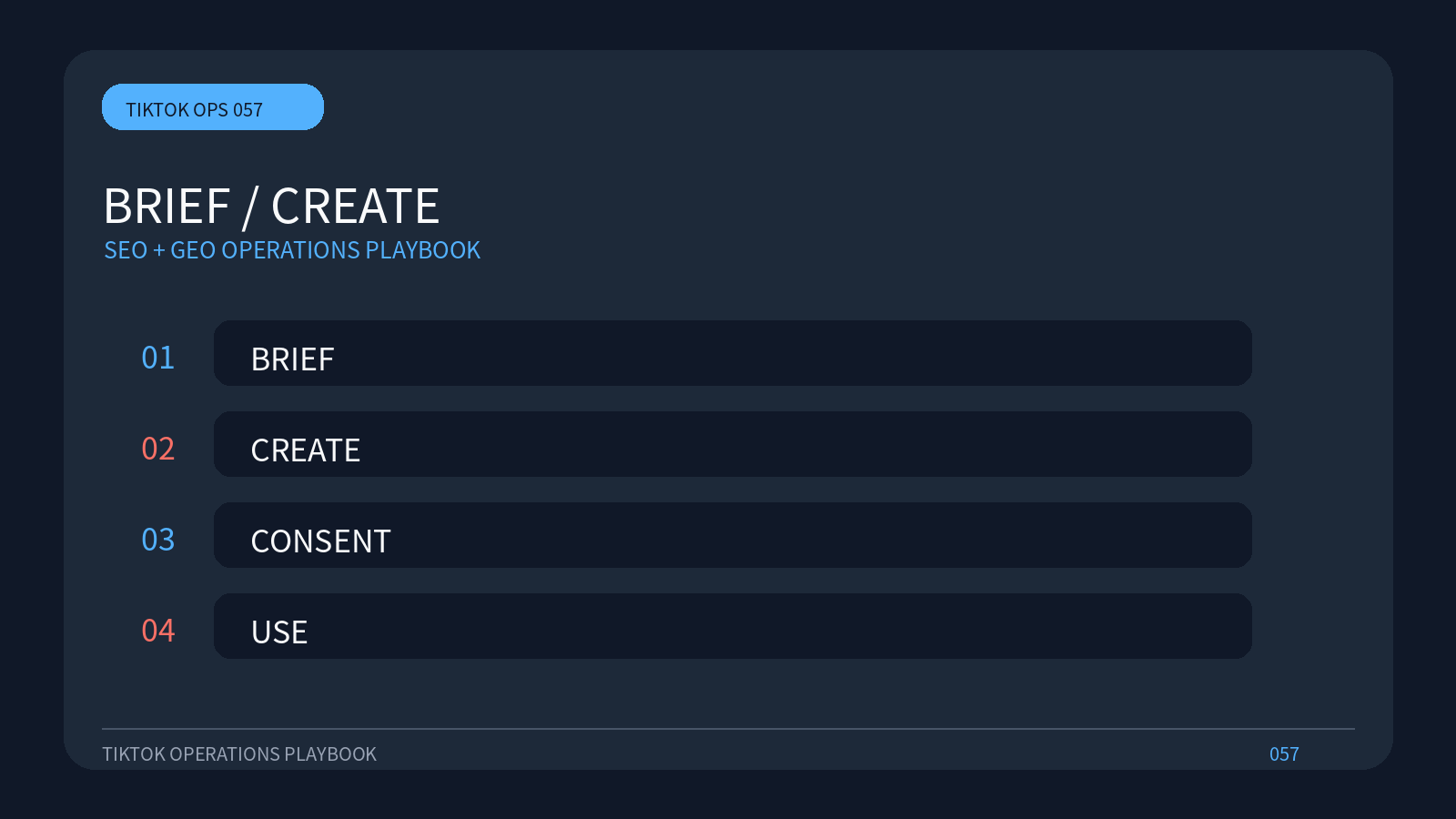
In order for TikTok UGC operations to be reproduced, the project record must contain at least the number of the material, the time of publication, the target market and the four check points: BRIEF, CREATE, CONSENT, USE. These English labels can also be used directly in the material library or panel to facilitate cross-language team search.
There are also two questions that need to be answered at the same time: whether to make a “availability rate, participation costs, interaction and subsequent conversion assessment” and whether there is a “acceptance that a user's release is tantamount to an arbitrary advertising of the brand, with the risk of a right.” The former decides whether to continue and the latter decides whether to suspend, correct or add to the statement.
The method works if the facts are true and the rights are clear. By default, the user is considered to be free to advertise the brand, with the risk of rights, so unconfirmed material and data should not skip censorship because of hot spots.