
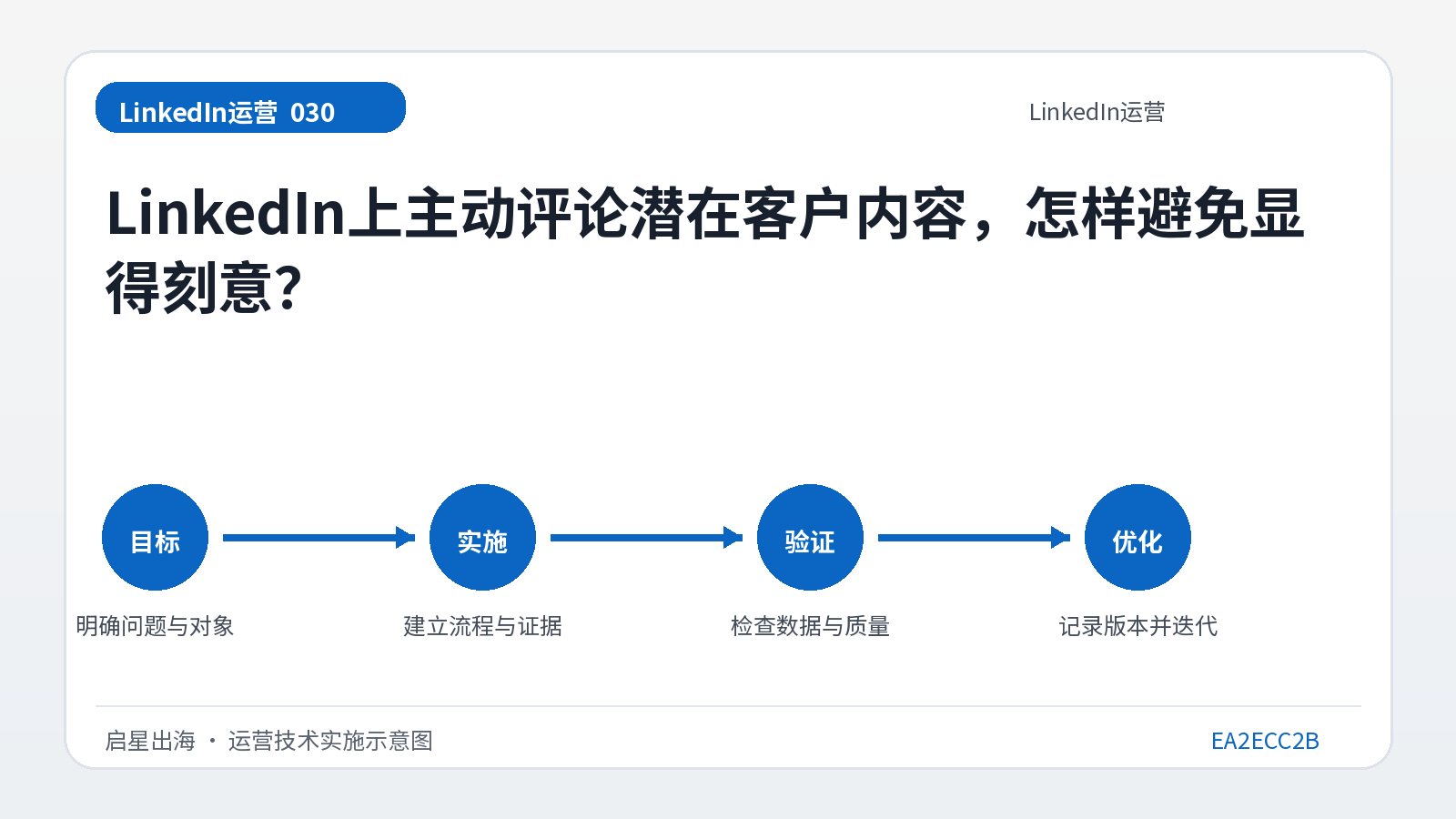
How to avoid appearing deliberate when proactively commenting on potential client content on LinkedIn?
POST

How to avoid appearing deliberate when proactively commenting on potential client content on LinkedIn?

Qixing Global analyzes the active comments on potential customers on LinkedIn, how to avoid common reasons, troubleshooting sequences, implementation methods and core indicators that appear deliberate, and helps individual SOHOs, internal to external factories and foreign trade teams improve the customer accuracy and effective business opportunities of LinkedIn's free natural flow.A common problem is using templated compliments or each item with product information, which fails to reflect true reading and professional value.

How to avoid appearing deliberate when proactively commenting on potential client content on LinkedIn?

From an operational perspective, the key to this issue is not “whether LinkedIn can do it”, but whether the current actions serve specific customers.Common problems are: using templated compliments or each item with product information cannot reflect true reading and professional value.

It is recommended to first create a customer decision-making table and write down the target customers, the scenarios that trigger the demand, the most worrying risks, the required evidence and the acceptable next step.Organic flow is determined not only by posting, but also by relationship relevance, review quality, ongoing conversations, and engagement after content; the number of interactions must be judged along with the identity of the target customer.This form prevents content or advertising from saying only what the company wants to say.

The practical action for this question is: only comment on business-related topics, quote specific opinions and add experiences, problems or different perspectives.After completion, the target roles are determined before publishing, and after publishing, timely reply to high-quality comments, participate in customer topics, record data access and conversations, and perform periodic reviews based on topics and groups of people..If multiple people are involved, the same set of product parameters, cooperation conditions, effective lead definitions and response criteria must be used to prevent customers from obtaining conflicting information at different links.

Review the target customer interaction proportion, repeat interactors, data access, search exposure, attention conversion, effective dialogue and content-assisted business opportunities every week, and randomly check real interactions and dialogues.The quality inspection of this question focuses on the quality of the other party’s reply, return visit information and follow-up dialogue.When it is discovered that invalid customers are concentrated from a certain theme, country or entrance, priority should be given to correcting the source rather than just asking sales to strengthen follow-up.

A healthy free organic flow system will gradually increase customer relevancy and sales efficiency, even if surface volume does not grow rapidly.As long as effective conversations, quotation opportunities, and trackable business opportunities continue to improve, the direction is right.

When implementing this question, you can first verify it with a small group of real target accounts: only comment on business-related topics, cite specific views and add experiences, questions or different perspectives.After execution, don’t just judge based on your feelings, but look at the quality of the other party’s reply, return visit information and follow-up conversations; at the same time, save the customer’s identity, version, date and subsequent sales results to avoid mistaking accidental replies for replicable methods.


Related content

The exposure of LinkedIn posts is getting lower and lower. How should we systematically troubleshoot?

Qixing Global analyzes the common reasons why LinkedIn posts are getting less and less exposed, how to systematically check the common reasons, the order of troubleshooting, execution methods and core indicators to help individual SOHOs, internal to external factories and foreign trade teams improve the customer accuracy and effective business opportunities of LinkedIn's free natural flow.A common problem is to attribute the decline entirely to the algorithm, without distinguishing between topic fatigue, relationship quality, format, posting time, and account number.

Read more →

A LinkedIn post has a lot of likes but no buyers. How to identify invalid interactions?

Qixing Global analyzes LinkedIn posts that have many likes but no buyers. How to identify common reasons for invalid interactions, troubleshooting sequences, execution methods and core indicators to help individual SOHOs, internal to external factories and foreign trade teams improve the customer accuracy and effective business opportunities of LinkedIn's free natural flow.A common problem is to only count total likes, ignoring that interactors may be peers, job seekers, suppliers, or non-target regions.

Read more →

How to reply in the LinkedIn comment section so that it can naturally transition into a business conversation?

Qixing Global analyzes the common reasons, troubleshooting sequence, implementation methods and core indicators of how to reply in the LinkedIn comment area to naturally transfer to business conversations, helping individual SOHOs, internal transfers to external factories and foreign trade teams to improve the customer accuracy and effective business opportunities of LinkedIn's free natural flow.A common problem is that the reply is only a thank you or an immediate sales pitch, which fails to continue the professional discussion and can easily make the other party defensive.

Read more →

