
The first step in solving the question “What B2B purchasing information should be included in your LinkedIn company profile?” is not to look for tips, but to eliminate wrong assumptions.The team probably understood the problem as insufficient traffic, but the real reason is that the introduction only states the year of establishment and product range, which cannot help buyers judge whether it is suitable.The two judgments lead to completely different actions.
Start by sampling recent content, interactors, or leads to answer three things: are they your target customers, do they understand your value, and are the next steps clear enough.The personal account is responsible for relationships and professional expression, while the company homepage is responsible for depositing brand facts, content assets and advertising undertakings. The division of labor between the two is more stable than operating either end alone.If you cannot answer one of the three items, it means that the company homepage still needs to be reconstructed.
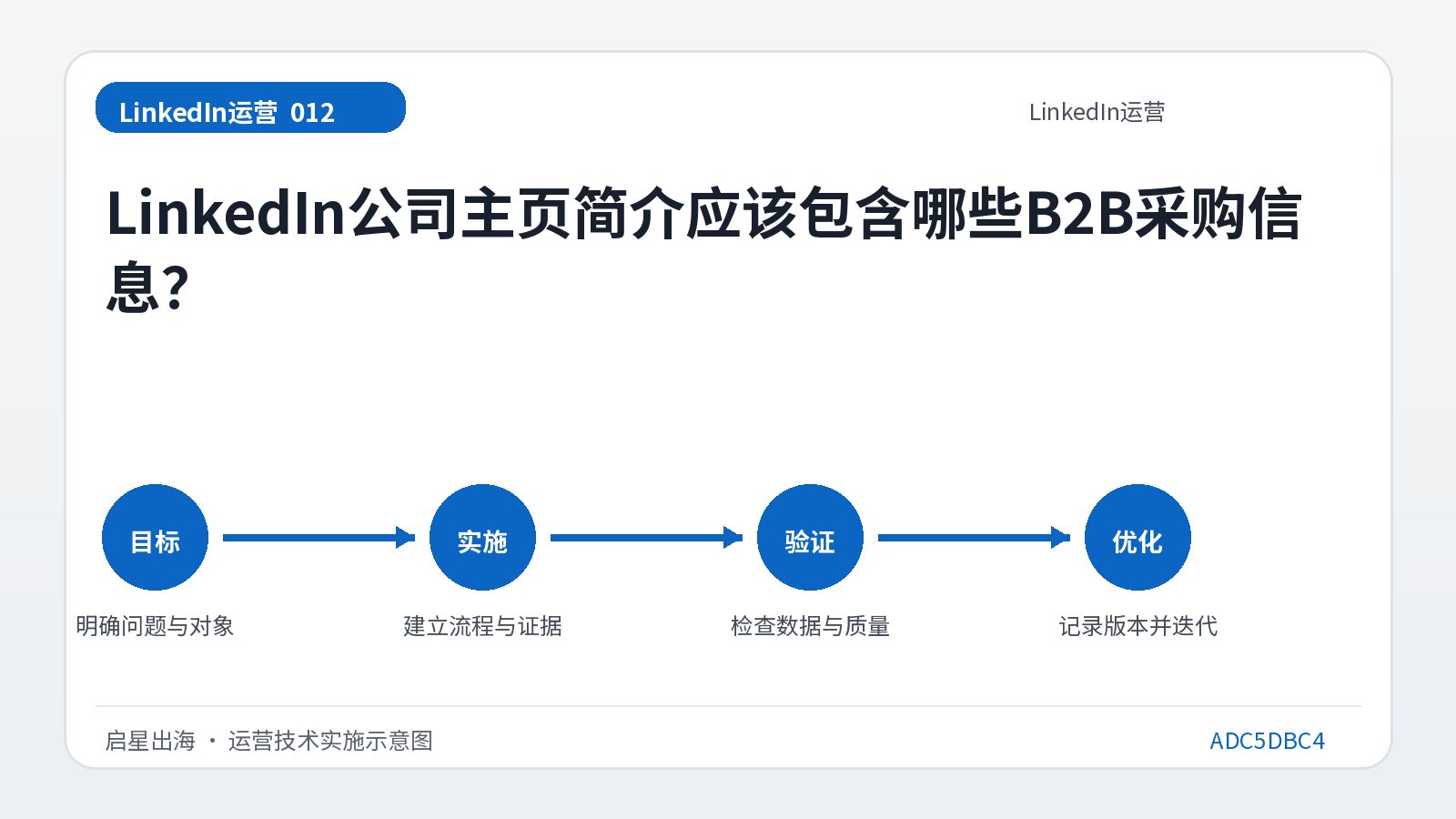
Prioritize implementation: clearly describe the service market, customer types, applications, core capabilities, cooperation conditions, quality evidence and official contact points.At the same time, the basic information of the company's homepage, content columns, employee identity association, homepage top and website entrance are established, and then personal account forwarding, comments and clue attribution methods are specified.order, do not skip the previous positioning and evidence and directly pursue the final inquiry.Only test one key difference in each round and set stopping conditions to avoid constantly adding resources without reaching a conclusion.
Evaluation metrics are divided into two categories: leading and results.Leading indicators are homepage visits, target follower growth, employee engagement, website clicks, content interaction quality, and lead sources, and outcome indicators are valid leads, offers, and business opportunities.This question tests whether visitors can quickly judge suitability and enter the website.Only when the two types of indicators are in the same direction can the changes be truly effective.
A common misconception is to immediately amplify when you see a drop in costs or an increase in engagement.The B2B sample is small, so customer identity and needs should be verified first, and then a stable period should be observed.Results that can be used by sales, can be followed up, and can be traced to their source are results worth retaining.
When implementing this question, you can first use a small group of real target accounts to verify: clearly describe the service market, customer types, applications, core capabilities, cooperation conditions, quality evidence and official contact points.After execution, don’t just judge by feeling, but test whether visitors can quickly judge suitability and enter the website; at the same time, save customer identity, version, date and subsequent sales results to avoid mistaking accidental replies for replicable methods.



