
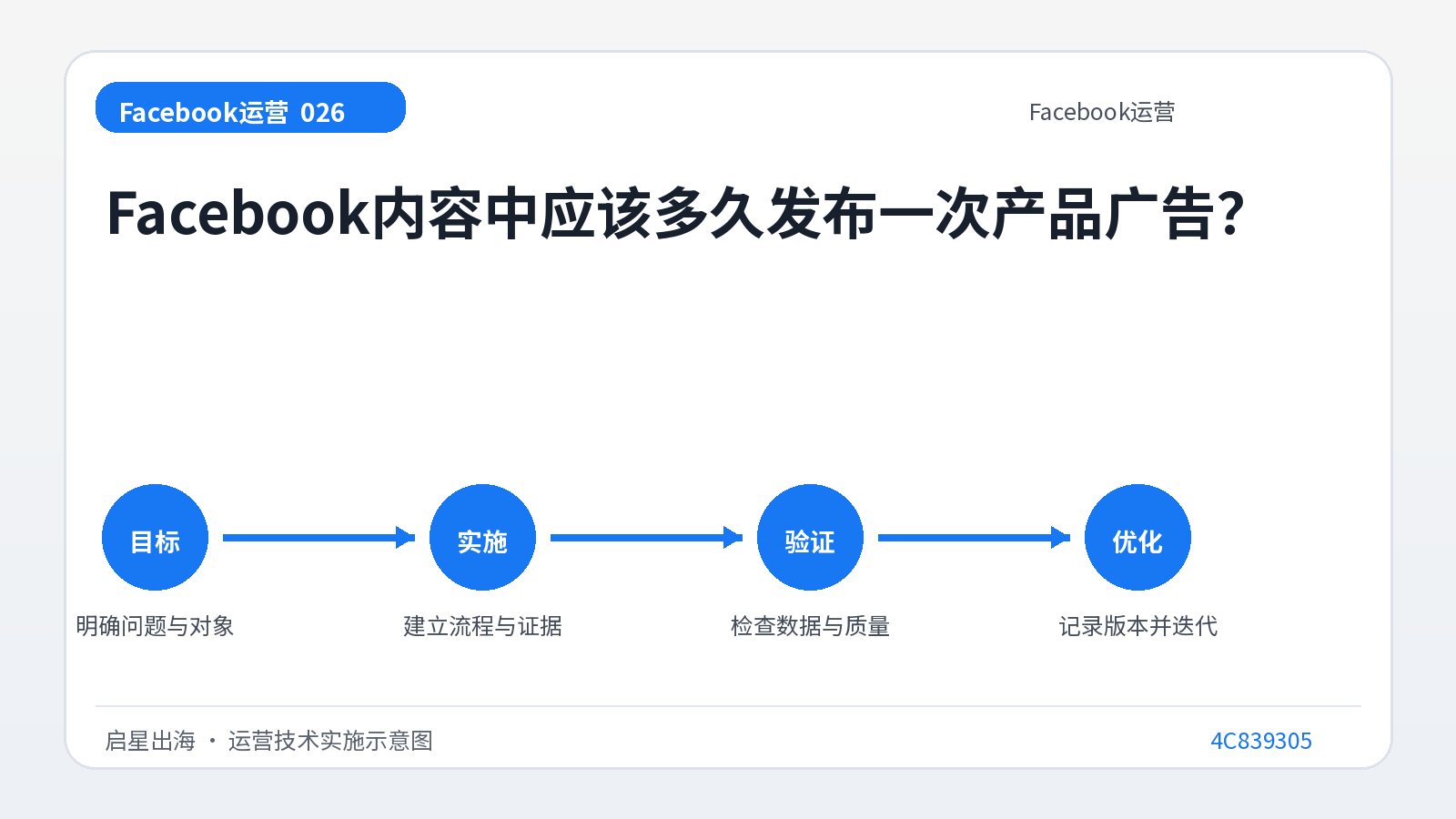
How often should product ads be posted in Facebook content?
POST

How often should product ads be posted in Facebook content?

Qixing Global analyzes the common reasons, troubleshooting sequence, execution methods and core indicators of how often product advertisements should be published in Facebook content, and helps individual SOHOs, internal to external factories and foreign trade teams improve Facebook's natural customer acquisition and effective inquiry quality.The main problem is often that continuous hard advertising will make the account lose reading value, and the product is not mentioned at all and it is unable to undertake purchasing needs.

How often should product ads be posted in Facebook content?

This question cannot be answered with a one-size-fits-all setting.The decision-making cycle of foreign trade B2B is long. First of all, we must determine whether the data is poor because no one has looked at it, because they are not interested, or because they are interested but have not entered the sales process.The most questionable thing at present is that continuous hard advertising will make the account lose reading value, and it will not mention the product at all and will not be able to undertake purchasing needs.

It is recommended to conduct a reverse check first: work backwards from the final quotation opportunity you want to obtain, and determine what content the customer needs to see, what evidence to obtain, where to click, and what information to submit.The mission of B2B content is to reduce customer judgment costs and help buyers understand the problem, compare options, verify suppliers and take the next step.If these steps are not connected, optimizing for reach, clicks, or fans alone will be difficult to produce stable results.

The first action in this question is: use a combination of education, scenarios, evidence, cases and conversion content, intersperse sales-oriented content, and adjust the proportion based on high-intent content feedback.Then follow the "use pain points, methods, evidence, cases and call-to-action structure to break down a big topic into pictures, short videos, long articles and questions and answers at different procurement stages." Check each item one by one.Don’t change positioning, materials, audiences, and hosting pages on the same day; if you change too many variables at once, you won’t be able to replicate the results even if they get better.

Two sets of data are used when measuring: the platform side checks the target customer’s stay, effective video viewing, saving and sharing, information retrieval, homepage visits and content-assisted inquiries; the sales side checks company matching, demand authenticity, quotation possibility and follow-up results.In particular, it is necessary to observe changes in customization, interaction quality, and inquiry sources to prevent the operations team from only reporting good-looking superficial data.

A practical judgment is: if the data is small but the customers are accurate, it can continue to be accumulated; if there is a lot of data but the customers are wrong, the screening and expression should be corrected immediately.It takes a week to observe execution issues, a month to judge trends, and then a complete procurement cycle to test whether content creation truly creates business opportunities.


Related content

If you don’t know what to write for Facebook B2B content, how can you build a long-term topic library?

Qixing Global analyzes the common reasons, troubleshooting sequences, implementation methods and core indicators of Facebook B2B content that you don’t know what to write about, how to build a long-term topic library, and helps individual SOHOs, internal to external factories and foreign trade teams improve Facebook’s natural customer acquisition and effective inquiry quality. The main problem is often that the product and holiday content will be repeatedly posted if the topic is chosen temporarily, making it difficult to form a stable professional label.

Read more →

There are a lot of product parameters, how to write a Facebook post so that it doesn’t look like an instruction manual?

Qixing Global analyzes many product parameters, including common reasons, troubleshooting sequences, execution methods and core indicators on how to write Facebook posts so that they don’t look like manuals. It helps individual SOHOs, inbound and outbound factories and foreign trade teams improve Facebook’s natural customer acquisition and effective inquiry quality. The main problem is often that all parameters are listed at once, which makes non-technical decision-makers miss the key points and lacks application significance.

Read more →

Should Facebook factory videos capture equipment or the production process?

Qixing Global analyzes the common reasons, troubleshooting sequence, execution methods and core indicators of whether Facebook factory videos should be shot on equipment or production processes, helping individual SOHOs, internal to external factories and foreign trade teams to improve Facebook's natural customer acquisition and effective inquiry quality. The main problem is often that simply scanning the machine can only prove that the equipment is available, but cannot prove process control and batch stability.

Read more →

