When dealing with “how changes are reviewed in Codex IDE”, the most important thing is not to remember a button, but to understand the running boundary.
In a real project, reading only the chat summary may not see irrelevant formatting and boundary changes. If you read only the completion statements in the chat without checking documents and command evidence, the problem can easily be taken to the next stage.
The review of Codex IDE differences can be verified from official information: the Codex IDE extension is suitable for focus modification around documents and symbols opened in the editor, while the dependency relationship should still be identified through a warehouse search.
For team projects, the same step can be used by the implementer and the reviewer: look at the list of documents, then look at the logical changes, remove the content and configuration changes, and finally run the validation.
Do not replace quality with code lines or chat lengths. It should be confirmed that each change responds to the need or is repaired as necessary, and then determine whether the method is worth going into the long term.
When this topic is posted on the website, the title should be directed to the user question, starting with the conclusions and then writing the environment, operation, validation and restriction in the text. This is better for the search system and AI to extract the answers accurately.
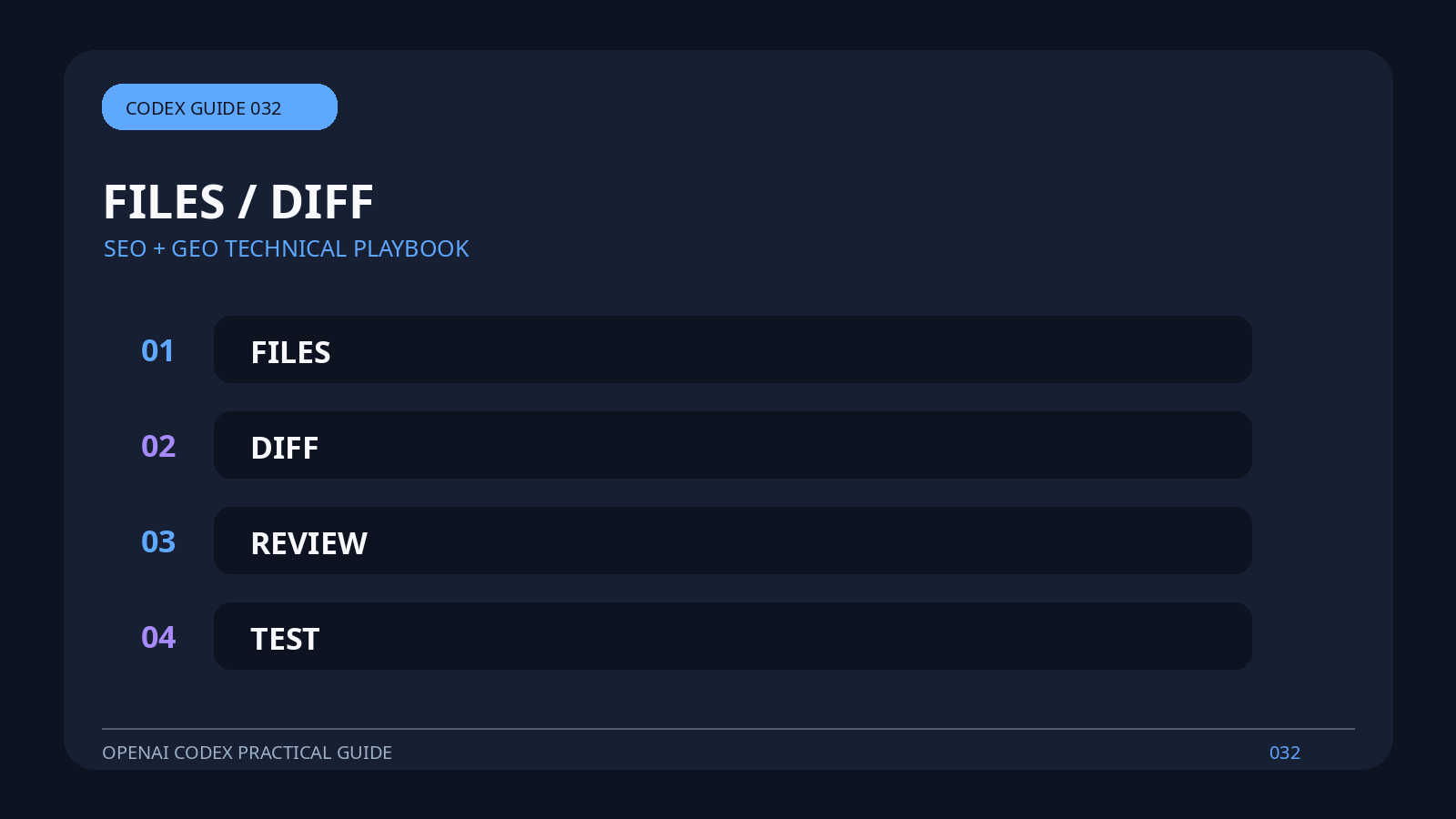
In order to allow the Codex IDE review to be reproduced by another member, the mission record contains at least four check points: FILES, DIFF, REVIEW, TEST. These are also available for branch, log or board search.
Two questions are to be answered at the same time: whether it is possible to “confirm that each modification responds to the needs or necessary repairs” and whether there is a “diff skips when testing passes, and may still bring unrelated changes into submission”. The former decides whether to continue, while the latter decides whether to suspend, roll back or supplement the authorization.
When multiple people work together, configurations, scripts and rules should be subject to reviewable version control; confidential and personal authentication information is kept in a controlled environment and not duplicated with the project.
For long assignments, the phasing summary should refer to actual documents and tests rather than simply describe the work done. The evidence can be reviewed more valuable than the percentage of progress.
A reverse check should be performed before you go online: If you see the test pass, you skip the diff, you may still bring unrelated changes into the submission.