
To analyse whether “low-quality old content should be deleted or retained” is correct, three questions can be asked first: whether the target URL is clear, whether the search engine side has steady access, and whether the user has the expected answer. Content cleansing is not a volume cut by the flow threshold, and a low-flow business page may serve important small clients or support conversion. None of these questions is valid, and there is no urgency to scale up.
Decision-making requires a combination of uniqueness, accuracy, links, conversion, compliance and maintenance costs. It is therefore not appropriate for an audit to export only an error list of tools, but rather to mark affected templates, business values, restoration costs and validation methods for each issue, addressing the problem of interdiction.
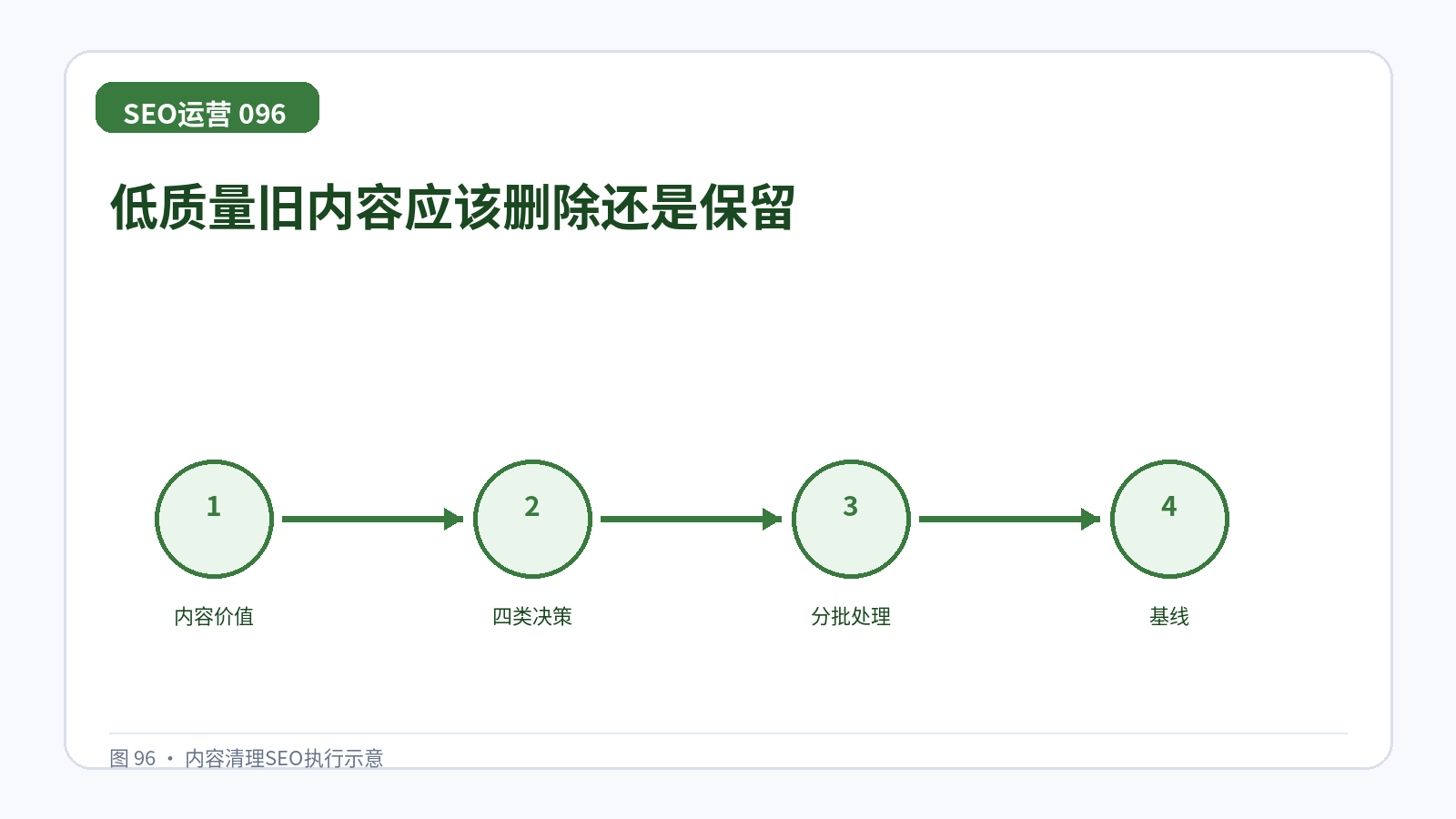
On implementation, the operating pages are divided into four categories: retention of updates, consolidation of 301, downline 404/410 and noindex, batching and preservation of maps and baselines.
The final performance review uses a sample of the same business pages: batch-monitoring of indexing, querying, external chain entrances and business transformations, with abnormalities that can be stopped in a timely manner. There are also cases where change orders have not improved, which tend to reveal rule exceptions or data calibre problems. A one-time stop deletion of hundreds of pages increases risk and does not identify the type of treatment that is really effective, so any batch operation should be validated first on the test environment and on a small number of production URLs.
In order to prevent the conclusion from remaining in the report, it is recommended that the value of content and the baseline be translated into the issuance of acceptances and acceptances, and that exceptions be analysed and repaired for how long. This way, the new business page follows the same standard and the old business page can be detected in a timely manner after the template changes.
When you actually reset, you can choose a successful business page and a failed business page in parallel. Clean up the content of SEOs to form change orders for their entry, content difference, capture status and transformation finals, making it easier to form the next clear-cut action than by looking at the average of the entire site.
If content and technical resources are limited, this method should be used first to generate a Query or to take on a business page of critical navigation. Four types of decision-making and batch processing can be passed steadily, then extended to a low-flow catalogue, avoiding cross-checking over-scope and unmanageable final performance.



