
To judge how FAQ content is written does not turn into a keyword stack, three questions can be asked: whether the target URL is clear, whether the search platform has steady access, and whether the user has the expected answer. The FAQ is first used to resolve real objections and additional target page information, rather than stacking all long end questions at the bottom of the page. None of these three questions is valid, and there is no urgency to scale up.
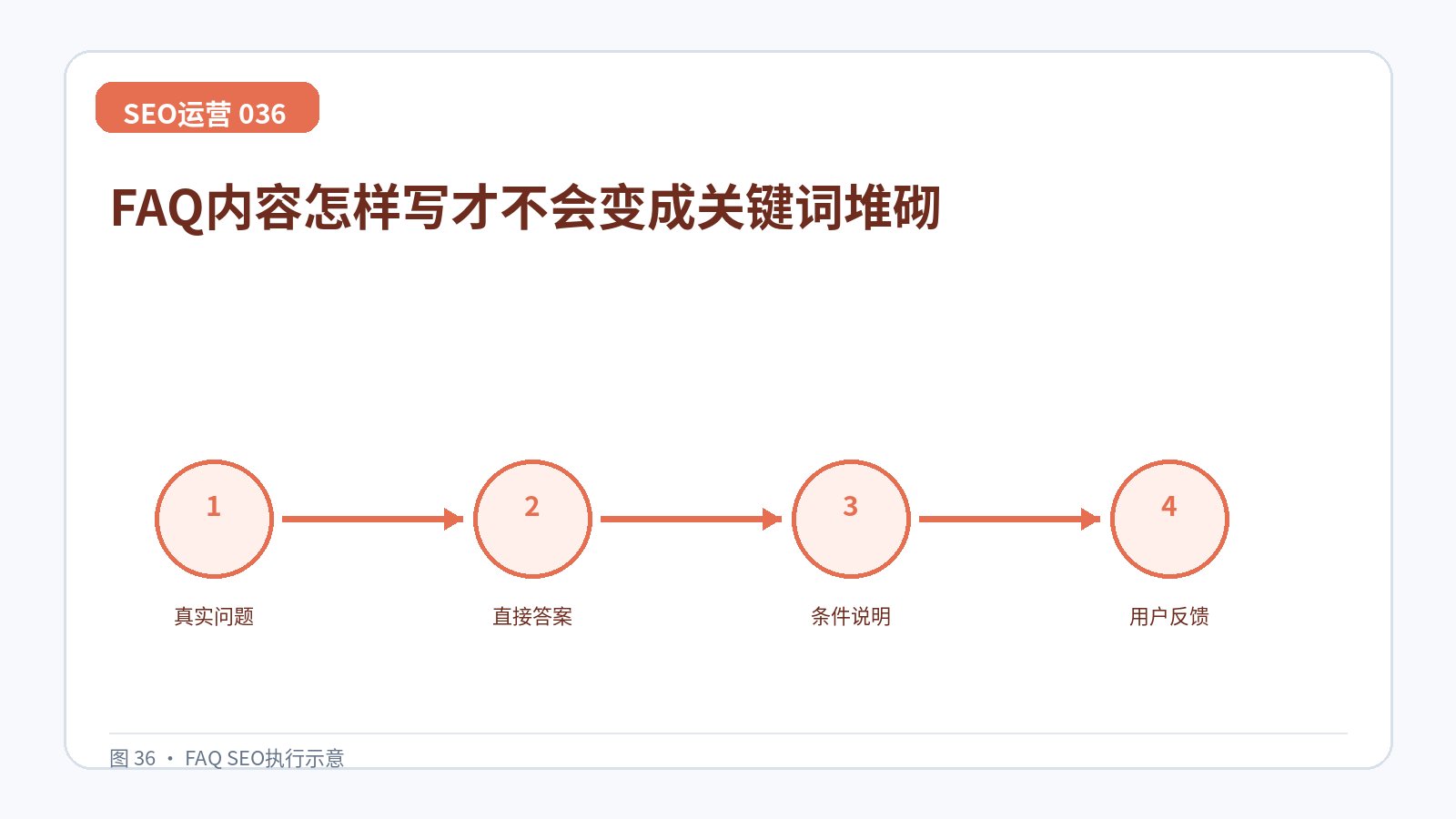
The questions should come from customer service, sales and in-station searches, and the answers are direct, specific and relevant to the subject of the current target page. It is therefore not appropriate for the audit to export only a list of errors in the tools, but rather to mark the affected template, business value, repair costs and validation methods for each question, first addressing the problem of interdiction.
On implementation, five to eight high-frequency (HF) questions are selected, with conclusions to be drawn before conditions or exceptions are specified; questions and answers to repeat the main text should be combined.
The results were reviewed using the same target page sample: tracking questions and answers, reduced in-site searches, quality of counselling and related query coverage. Unimprovised cases are also kept, which often reveal rule exceptions or data calibre problems. Replicating a large number of FAQs to each page in order to obtain a rich media result would result in duplication and lack of assurance of special displays, so any batch operation should be validated first on the test environment and on a small number of URLs.
In order to prevent the conclusion from remaining in the report, it is recommended that real problems and user feedback be treated as input acceptances and that the anomaly be judged by whom and how long it will be repaired. This way, the new target page will follow the same standard and the old target page will be discovered in time after the template changes.
When you actually reset, you may choose a successful target page and a failed target page to be compared. It is easier to save their entry, content, capture status and transformation around FAQ SEO than to look at the average of the entire station.
If the implementation team has limited resources, this method is used first on target pages that can generate queries or take on critical navigation. Direct answers and condition statements can be passed steadily, then extended to the low-flow catalogue, avoiding over-impact reviews and unprocessed results.