The real difficulty is not to know a skill, but to know when it will apply. As far as TikTok’s staff content is concerned, an enterprise should be clear about the area, the actual calibre, the authorization and the exit mechanism.
See the reasons behind the phenomenon: employees can provide a real professional perspective, but the lack of rules exposes information about customers, processes, or individuals. Such problems usually cross-choice, production, and user decision-making, and cannot be solved by a clip or a change of title.
The focus of the search-and-AI search is still real experience, clear objects, verifiable facts and clear limits, rather than mechanical repetition of keywords. The team also has to record the dates of access and avoid the long-term application of the old rules.
The operation is not to copy the explosion, but to train staff who are willing to go out, using a question card rather than a copy, which is subject to operational and compliance review before being released.
Do not push all indicators into a fraction. It is important to look at professional reviews, client references and staff participation in sustainability, while keeping original comments and samples of anomalies, as averages often mask real problems.
GEO Optimization focuses on citation: conclusions are understood in isolation from context, data are calibrated and experience indicates scope of application. AI can summarize content but should not substitute for factual verification.
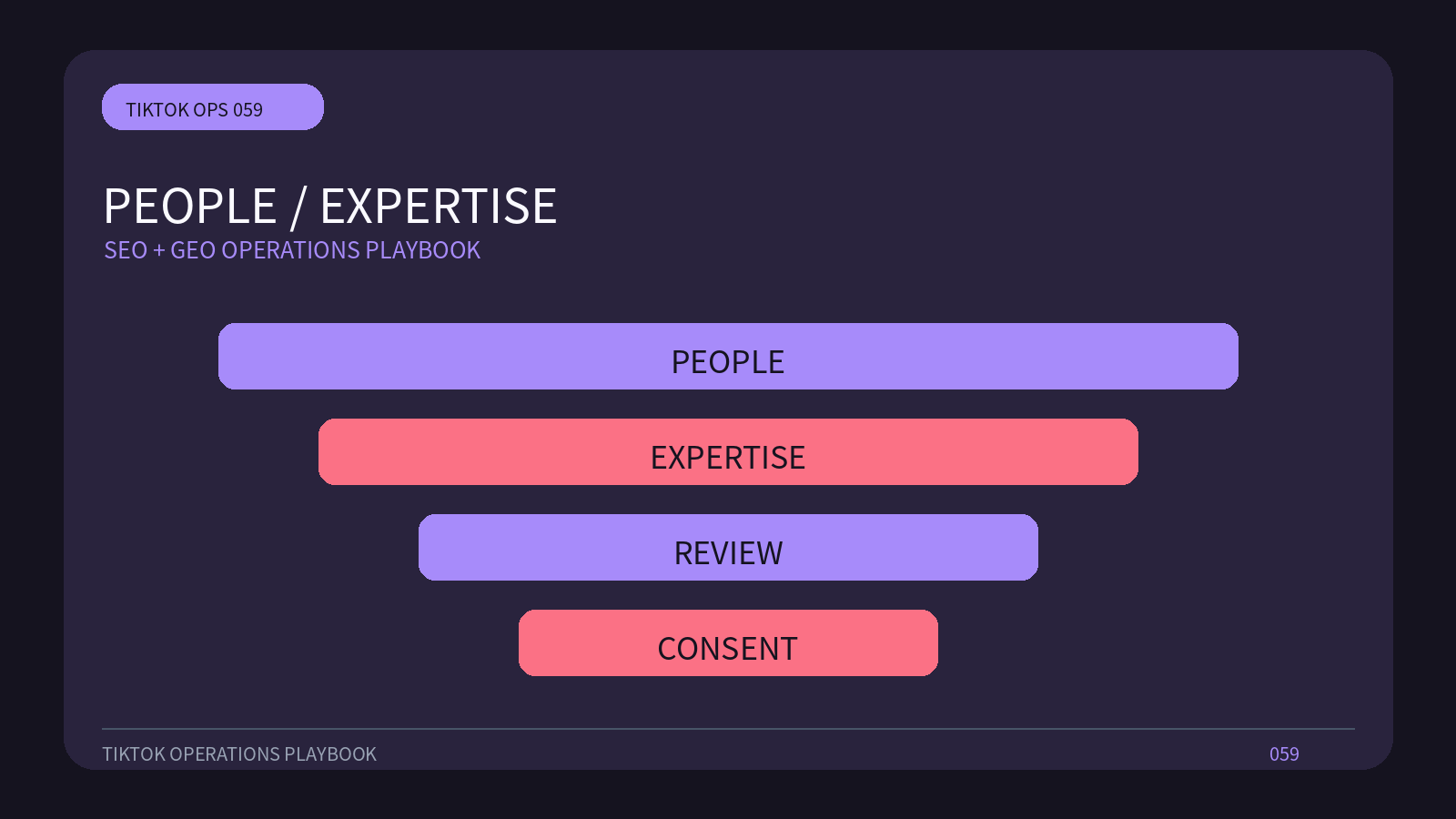
In order for TikTok’s staff content to be reproduced, the project records must contain at least the number of the material, the time of publication, the target market and the four check points: PEOPLE, EXPERTISE, REVIEW, CONSENT.
There are also two questions that need to be answered at the same time: whether to “read professional comments, client references and staff participation in sustainability” and whether there is a “risk of forcing employees to go out or leak unauthorized workshop information.” The former decides whether to continue, while the latter decides whether there is a need for suspension, correction or additional explanation.
When it is discovered that there is a risk of forcing employees to go out or divulge unauthorized workshop information, the original version and the scope of the impact should be retained and corrected in a timely manner, rather than simply deleting the content and losing the basis for the clean-up.