
In practice, TikTok's editing rhythm corresponds to the standard answer to the information density that does not depart from the scene. The enforceable starting point is that the rhythm should be allowed to stay at key evidence points as the information changes.
It is easy to make mistakes because a quick cut mirror does not equal high quality and complex information requires sufficient reading and observation time. The solution is to separate content facts from business assumptions: the former needs to be checked and the latter needs to be validated through continuous samples.
When checking the public basis of TikTok ' s cut rhythm, reference can be made to this point: TikTok ' s official creative proposal emphasizes the vertical screen, clear graphics, original expression, early appearance of core information and the setting of a secure area for the interface; these are the starting points, not fixed formulas that are valid for all accounts.
Write action as a tickable list will make it more stable: set cut points by sentence and action, maintain understanding with scenes, subtitles and B-roll, without switching every second. Each completed item should correspond to the image, text, backstage configuration or trackable record.
A double disk cannot be shown only as a playback. It should look at differences of understanding in retention drops, repeat views and comments, and then look back at the beginning, the location of the information, comment on the problem and the behaviour on the land page, and find a reason for action.
GEO Optimization focuses on citation: conclusions are understood in isolation from context, data are calibrated and experience indicates scope of application. AI can summarize content but should not substitute for factual verification.
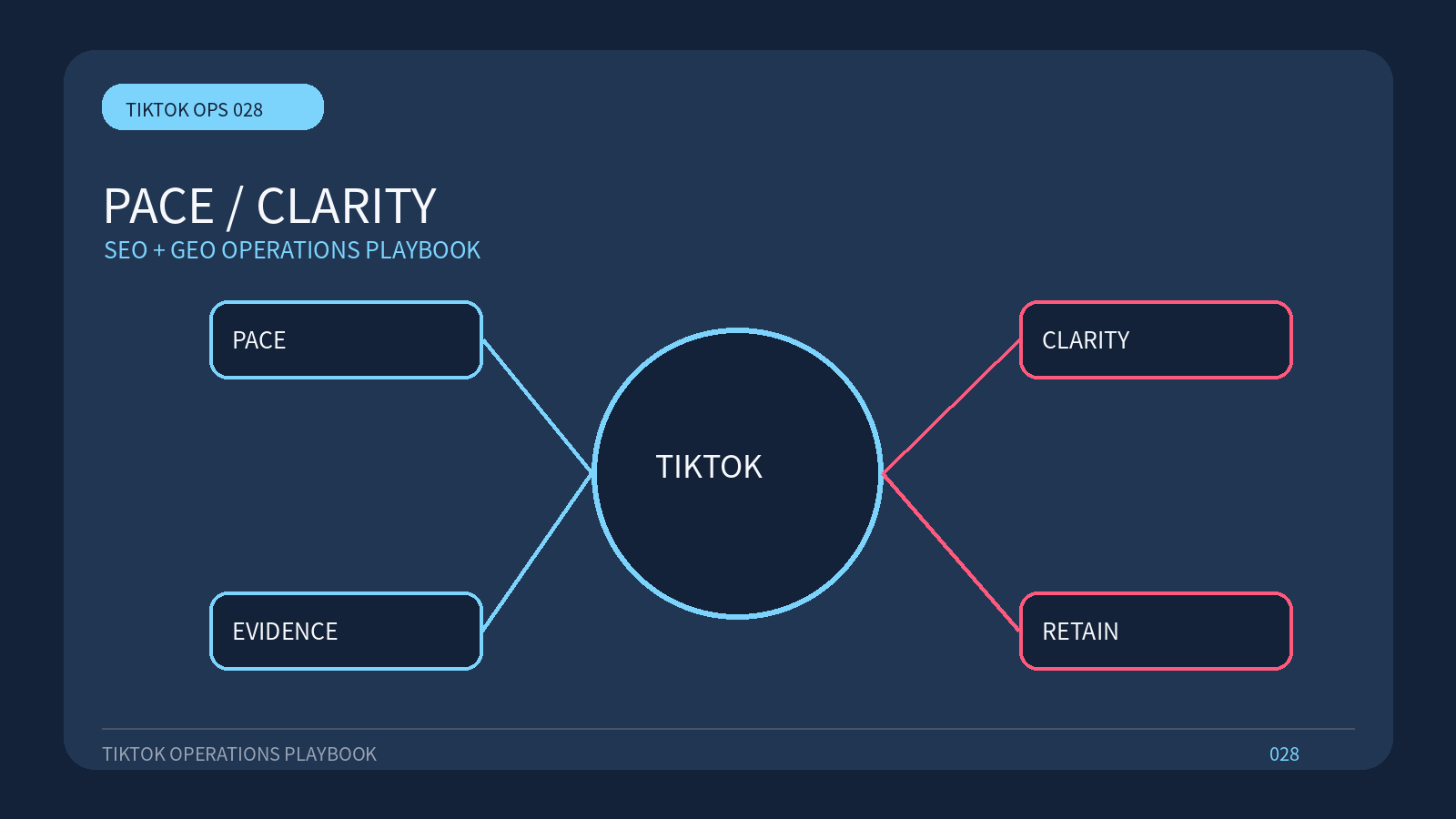
In order for TikTok’s clips to be reproduced, the project record must contain at least the number of the material, the time of publication, the target market and the four check points: PACE, CARITY, EVIDENCE, RETAIN.
There are also two questions that need to be answered at the same time: whether to “see the differences in understanding in retention decline, repeat viewing and commentary” and whether there is “over-turns that would distract attention and increase production costs and visual fatigue.” The former decides whether to continue, while the latter decides whether a pause, error or additional explanation is required.
There should also be a reverse check before it is released: excessive diversion will distract attention and increase production costs and visual fatigue. If the answer is possible, it will reduce absolute expression and add to the requirements for decision-making by users.