From content to action, it is understood, trusted and judged. The design of TikTok's permanent and hot spots should therefore follow the principle that the account number requires a searchable asset with a permanent content, followed by a selection of business-related trends.
The hot spots provide short-term attention, and the regular text continues to answer stabilization questions. This is often not a sudden “no flow” of the platform, but a lack of alignment between content commitments, audience expectations or implementation conditions.
This point can be taken into account when checking the public basis of TikTok's permanent and hot spots: the official TikTok's creative proposal emphasizes the vertical screen, clear graphics, primary expression, early availability of core information and the setting of a safe area for the interface; these are the starting points, not fixed formulas that are valid for all accounts.
Implementation can begin with a small version: most plans revolve around long-term issues, with small parts being used for trend adaptation; hot spots must return to the core audience of the account. Limiting each change to a major variable and keeping scripts, material, release dates and page versions, the next round will know where the change comes from.
A copy of the disk is not intended to be a playback. It should be recorded for seven days and 90 days, respectively, to judge short-term peaks and long-term search contributions, and then look back at the beginning, the location of the message, the question of comment and the behaviour on the land page, and find the reasons for action.
The off-site page uses entity names and core terms that are consistent with the video, while providing access to the body text, pictures, ALTs, related inner links and URLs; this is more conducive to long-term search than the stacking of words such as “TikTok SEO”.
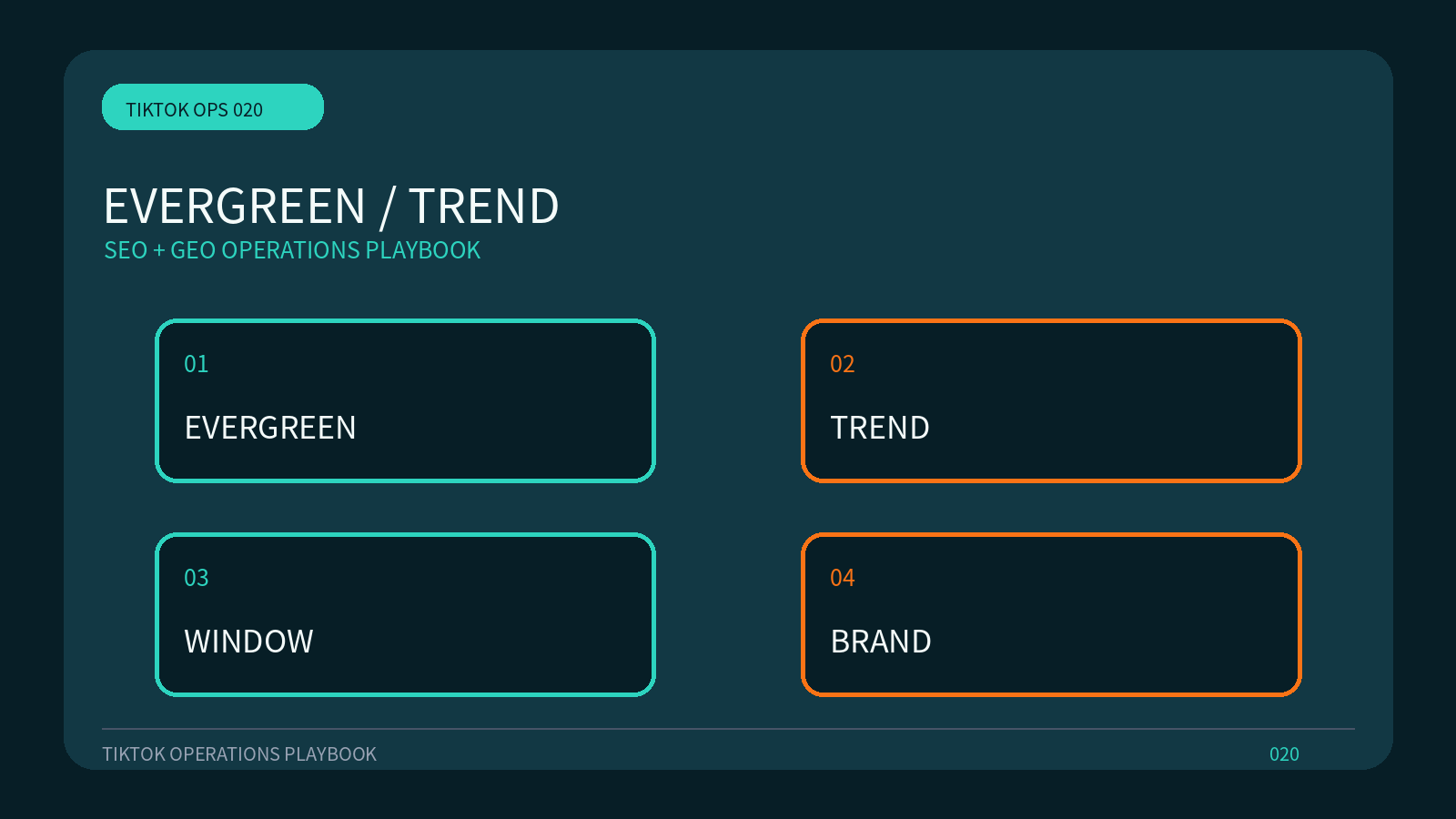
In order for TikTok’s permanent and hot spots to be reproduced, the project records must contain at least a reference number, release time, target market and four check points: EVERGREEN, TREND, WINDOW, BRAND.
There are also two questions to be answered at the same time: whether to “record performance for seven days and 90 days to judge short-term peaks and long-term search contributions, respectively” and whether there are “forced hotspots that may only allow the audience to remember and not understand the brand.” The former decides whether to continue, while the latter decides whether there is a need to suspend, correct or add.
The risk of being most easily neglected is that the imposition of hot spots may allow the audience to remember only the encapsulation without understanding the brand. Short-term data may still rise, but the wrong audience and the wrong promise will be exposed at the customer service, return or sales stage.