The answer to this question depends on the target of the account, but there is a clear line: the statement should complement the video context, key entities and the message of action, rather than copying all the lines. First, the criteria of judgement are clear, then the tools and frequency of publication are discussed.
It is often not the platform's sudden “no traffic”, but the content commitments, audience expectations or conditions for implementation are not aligned.
The Platform’s public information provides a boundary for this topic. Creator Seach Insights can be used to observe search themes and content gaps, but the heat of the search is still judged in relation to the target customer, account capacity and subsequent transformation.
The operation is not a copy of the explosion, but an accurate summary of the problem in the first sentence, an intermediate additional condition or model, and a small number of relevant labels and next steps at the end.
A week of implementation, January of trends, and a full business cycle of sales impacts.
In order to obtain long-term search value, the core issues in the video can be expanded to stand-alone pages, to preserve real case and operational evidence, and to align page titles, main titles, URLs with content themes.
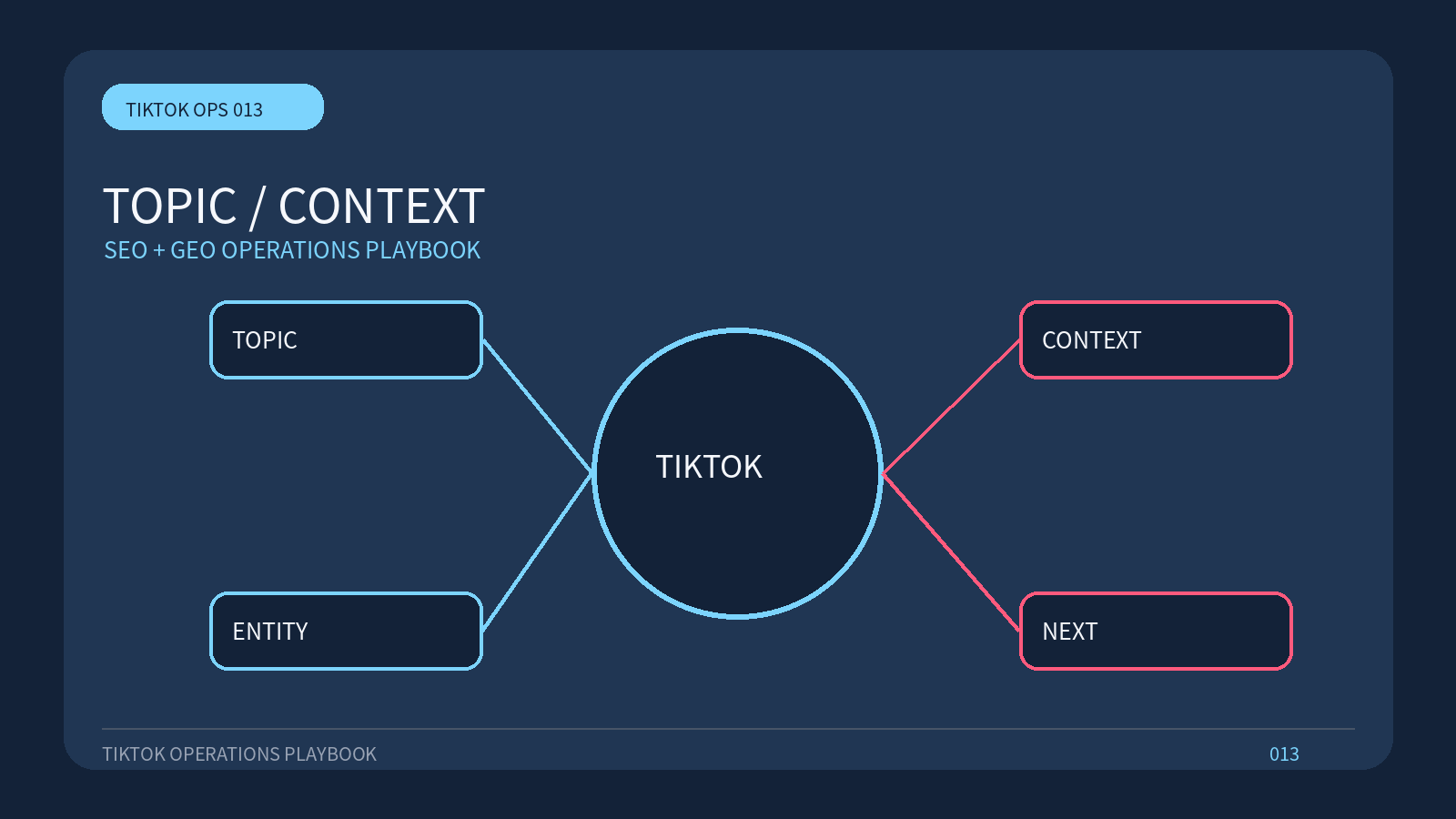
In order for TikTok videos to be reproduced by others, the project records must contain at least the number of the material, the time of publication, the target market and four check points: TOPIC, CONTEXT, ENTITY, NEEXT.
Two questions are also answered at the same time: whether “a search of the portal, a shared understanding and an off-site reference for clarity” is achieved, and whether “a large number of irrelevant keywords may attract the wrong audience and reduce trust.” The former decides whether to continue, while the latter decides whether there is a need for suspension, correction or additional clarification.
The method works if the facts are true and the terms are clear. The insertion of a large number of irrelevant keywords may attract the wrong audience and reduce trust, so unconfirmed material and data should not skip scrutiny because of hot spots.