
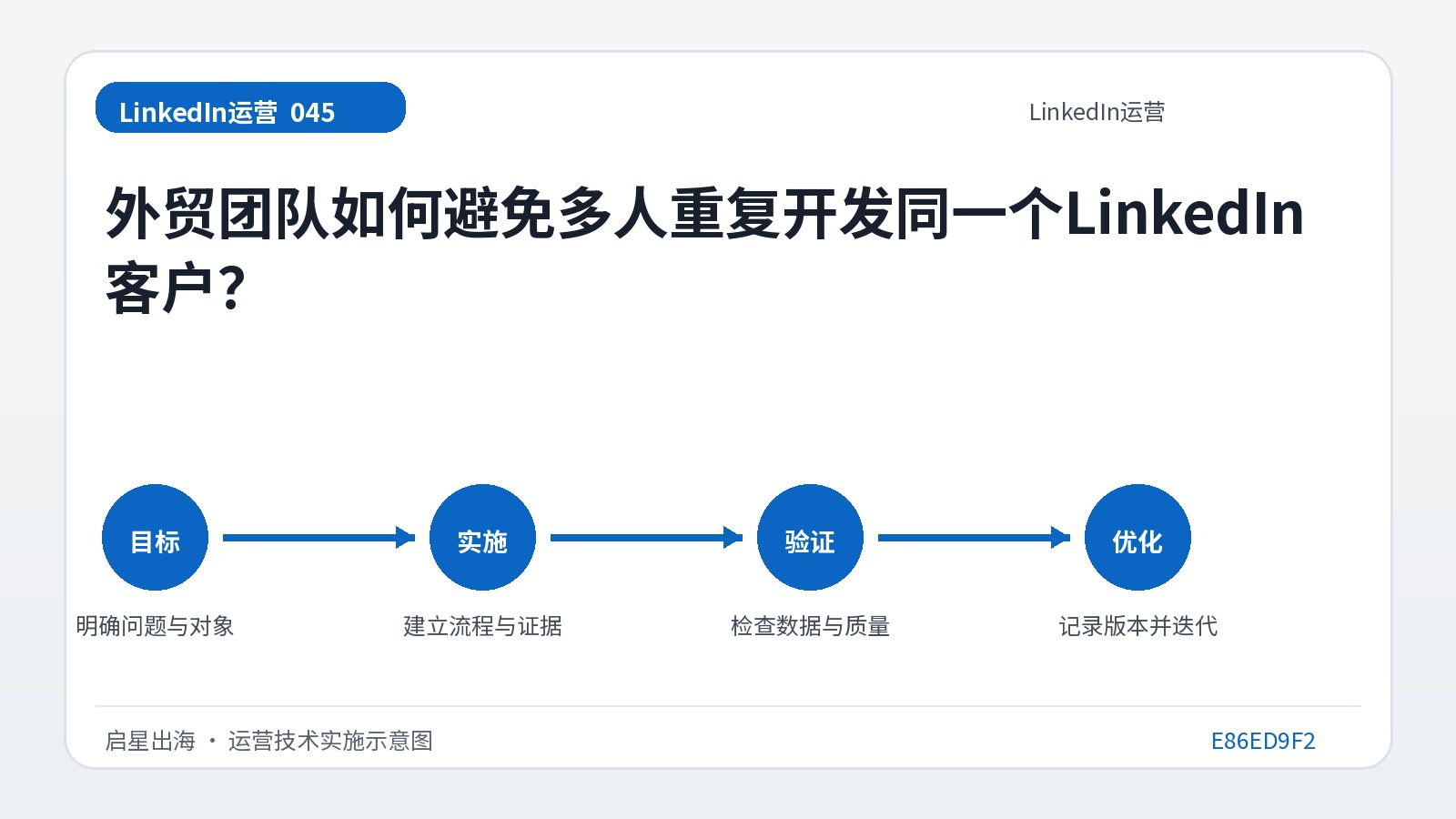
How can the foreign trade team avoid multiple people developing the same LinkedIn client repeatedly?
POST

How can the foreign trade team avoid multiple people developing the same LinkedIn client repeatedly?

Qixing Global analyzes the common reasons, troubleshooting sequence, implementation methods and core indicators of how foreign trade teams can avoid repeated development of the same LinkedIn customer by multiple people, and helps individual SOHOs, internal to external factories and foreign trade teams improve the accuracy and effective business opportunities of LinkedIn's proactively developed customers.A common problem is that the list is scattered across personal tables, lacking account unique identifiers, responsible persons, and conflict rules.

How can the foreign trade team avoid multiple people developing the same LinkedIn client repeatedly?

When encountering this situation, first separate the "no effect".Is it insufficient coverage, inaccurate interaction, loss after clicking, poor form quality, or sales not being taken on in a timely manner?The most likely reason is that the list is scattered across personal tables and lacks unique account identifiers, owners, and conflict rules.

Different breakpoints correspond to different solutions: for coverage issues, look at themes and distribution, for interest issues, look at hooks and scenarios, for trust issues, look at cases and proofs, for action issues, look at pages and CTA, and for quality issues, look at filtering conditions.The efficiency of active development is first determined by the ideal customer profile and the quality of the target account. Precise search is not a pile of product keywords, but a combination of industry, region, scale, application, position and business signals.Not all breakpoints can be solved with increased budget.

It is recommended to first use the company domain name as the primary key to enter the CRM and record the contact person, source, person in charge, status and recent actions. Then define the ICP and exclusions first, then establish the target company list, decision-making role map, search formula and verification fields, and save and review them in batches in Sales Navigator or basic search.Check upstream and downstream.When establishing a control group, keep the country, time, and customer type as consistent as possible, otherwise cost changes may simply be differences in market conditions.

In terms of data, you can also check the target company matching rate, decision-making role coverage, effective list rate, data access, response rate and dialogue to enter the demand confirmation.What's more important is to monitor duplicate reach and attribution disputes, and let sales flag invalid reasons such as retail, job search, wrong region, no company, demand mismatch, or duplicate leads.Reason classification can guide optimization better than a sentence of "inaccuracy".

The conclusions of the review must be transformed into the next round of actions: what to keep, what to delete, what to test, who will complete it, and when to check.In this way, customer search will turn from a scattered operation into a customer acquisition asset that can be continuously accumulated.

When implementing this question, you can first use a small group of real target accounts to verify: use the company domain name as the primary key to enter the CRM, record the contact person, source, person in charge, status and recent actions.After execution, don’t just judge based on your feelings, but monitor repeated contact rates and attribution disputes; at the same time, save customer identity, version, date and subsequent sales results to avoid mistaking accidental responses for replicable methods.


Related content

Before LinkedIn takes the initiative to develop, how to define an executable ideal customer profile ICP?

Qixing Global analyzes the common causes, troubleshooting sequence, execution methods and core indicators of how to define an executable ideal customer profile ICP before LinkedIn actively develops it, helping individual SOHOs, internal to external factories and foreign trade teams improve the customer accuracy and effective business opportunities of LinkedIn active development.A common problem is that the portrait only describes the industry and country, without company size, customer type, application, purchasing conditions and exclusions.

Read more →

Why do I find most peers and suppliers when searching for product keywords on LinkedIn?

Qixing Global analyzes why people search for product keywords on LinkedIn. Most of what they find are common reasons, troubleshooting sequences, implementation methods and core indicators from peers and suppliers. It helps individual SOHOs, internal to external factories and foreign trade teams improve the customer accuracy and effective business opportunities actively developed by LinkedIn.A common problem is that product words appear more often in supplier profiles, and buyers may use application, industry, or job language.

Read more →

How to choose between LinkedIn basic search and Sales Navigator?

Qixing Global analyzes the common reasons, troubleshooting order, implementation methods and core indicators of how to choose LinkedIn's basic search and Sales Navigator, helping individual SOHOs, internal to external factories and foreign trade teams to improve the customer accuracy and effective business opportunities proactively developed by LinkedIn.A common problem is to treat tool upgrades as strategy upgrades without first verifying the target market, filtering conditions, and daily follow-up capabilities.

Read more →

