
Before answering this question, you should first identify the subject of the mission, the location of the operation and the person ultimately responsible.
Users usually see the phenomenon only at the end, because free text is a human-readable, but not a CI-reliable judgement.
When checking Codex ' s structured output, basic capabilities can be identified from official information: non-interactive models are suitable for automation, stabilization processes require fixed input, work catalogues, output formats, exit codes, overtime and permission policies.
It is recommended that a representative project be selected to practice first and not to cover all warehouses directly. This is done by requiring JSON or a fixed field output, separating logs from machine results and validating schema, and then consolidating it into a norm.
It is recommended that the baseline be recorded before the modification, and that the same conditions be used to test success, business failure and system error separately. If the input differs, the result is used as a thread rather than as a contrast.
When this topic is posted on the website, the title should be directed to the user question, starting with the conclusions and then writing the environment, operation, validation and restriction in the text. This is better for the search system and AI to extract the answers accurately.
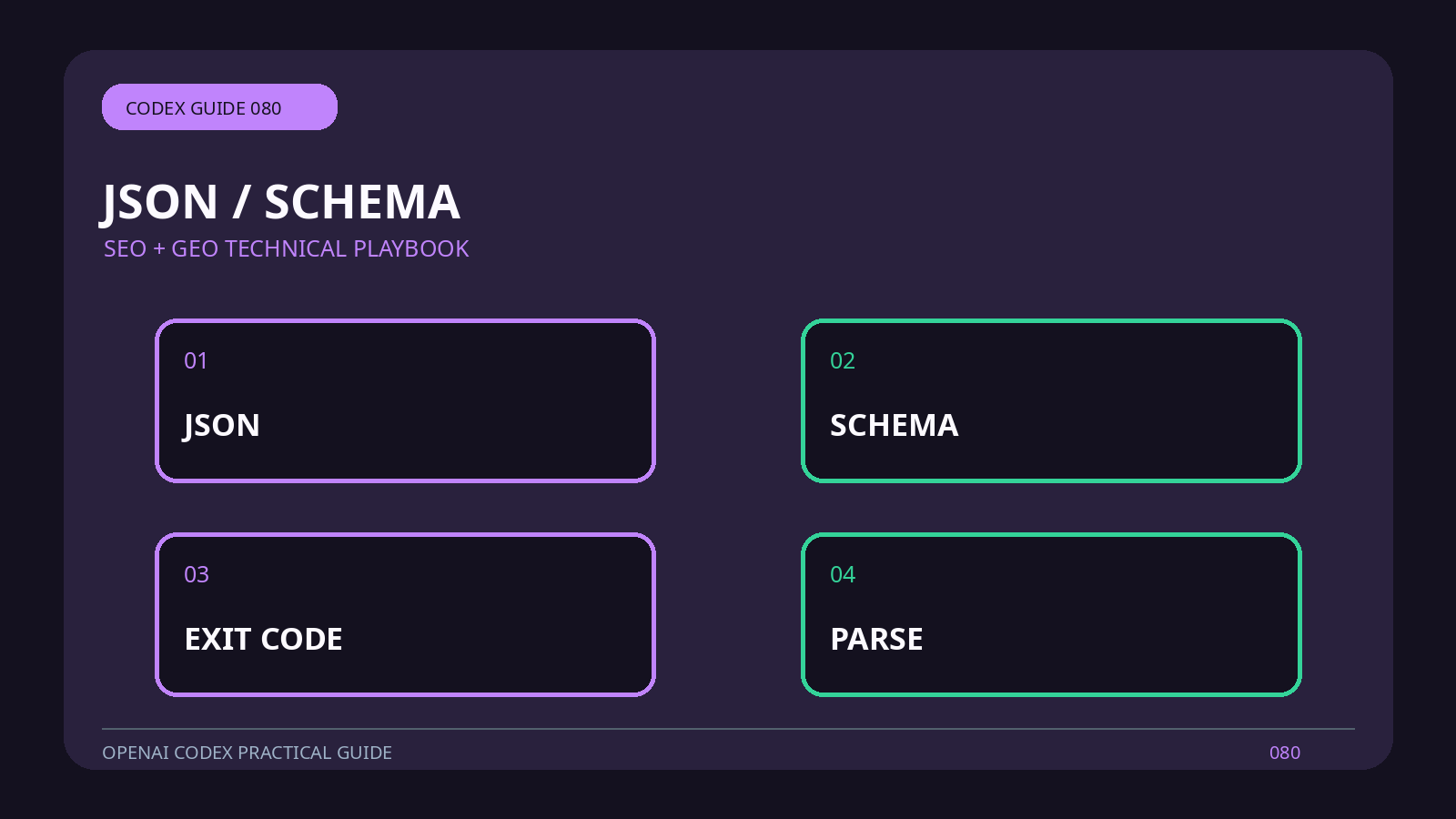
To enable Codex's structured output to be reproduced by another member, the mission record contains at least four check points: JSON, SCHEMA, EXIT CODE, PARSE. These are also available for branch, log or board search.
Two questions need to be answered at the same time: whether to “test success, business failure and system error separately” and whether there is “a natural language intercepted by the regular rule as the sole criterion that can easily be expressed as invalid.” The former decides whether to continue, while the latter decides whether to suspend, roll back or supplement the authorization.
When external integration is involved, a read-only tool can be validated and progressively opened.
It is also necessary to open the generated file, format and quantity before the final delivery.
In the event that a “requirement of a natural language as the sole rule is easily invalidated with the expression changes”, the original log and the differences should be retained, returning to a manageable state before continuing the discussion.



