When the team uses Codex, it needs to transfer personal experience to a way that others can repeat it.
There is an irreversible risk of data structural change, and code adoption does not represent historical data security. For multi-person collaborative warehouses, this also affects the unsubmitted work of branches, configurations and others, which cannot be processed as a personal test catalogue.
OpenAI Docs provides the current boundary for this topic. OpenAI Docs recommends that objectives, context, limitations, and authentication be clearly stated; complex tasks also require clear stages, conditions of cessation, and observable results. The actual project still needs to be validated in conjunction with the version and organizational strategy.
Write this in a taskcard that will make it clearer. The card lists objects, permissions, input and acceptance, and then executes: read the existing schema and migration norms, generate repeatable scripts, rehearse the copy data and record the rollback policy.
The receipt and inspection can be written as an automatic check and manual review. Automatic partial operating commands, which manually partially check the compatibility of old data, constraints, indexing and application versions, lead to a common conclusion.
When this topic is posted on the website, the title should be directed to the user question, starting with the conclusions and then writing the environment, operation, validation and restriction in the text. This is better for the search system and AI to extract the answers accurately.
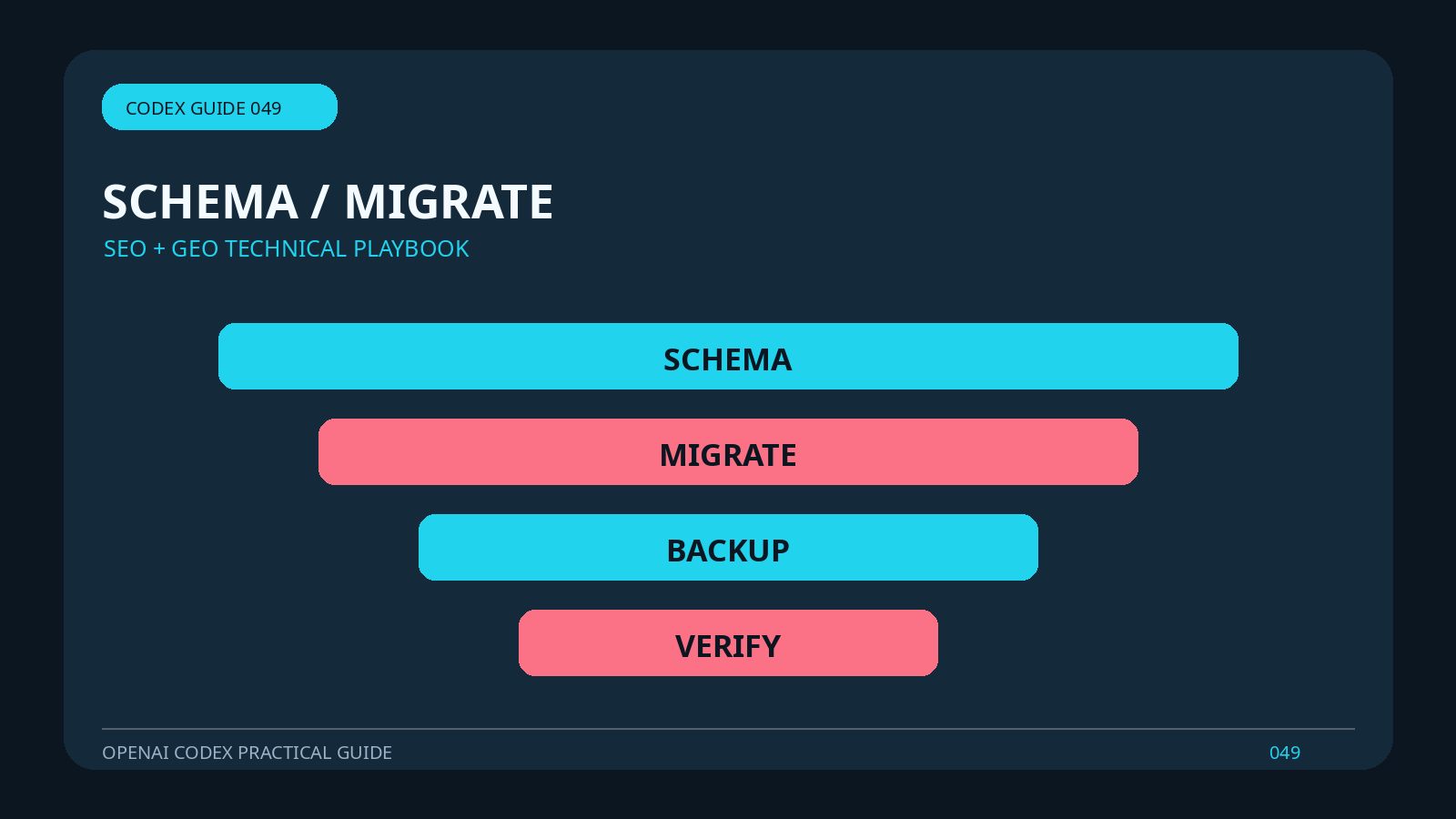
In order to enable the Codex database to be migrated and reproduced by another member, the mission record contains at least four check points: ScheMA, MIGRATE, BACKUP, VERIFY.
Two questions are to be answered at the same time: whether to “check the compatibility of old data, constraints, indexing and application versions” and whether there is “a failure to perform unrehearsed migration directly in the production bank that could cause a downtime or data damage”. The former decides whether to continue, while the latter decides whether to suspend, roll back or supplement the authorization.
For non-technical users, the delivery notes should be separated from “modified” “executed inspection” “unvalidated matters” and avoid considering the technical log as the final result.
Do not equate automation success with business correctness.