
Distinguishing between functionality can be used and delivery is reliable. The function is able to execute an order, and does not mean that the result is safe; it improves the detectability and sample quality before verifying assumptions.
In the absence of a stable recurrence of an occasional problem, a single success cannot prove that it has been repaired. For multi-person collaborative warehouses, this also affects the unsubmitted work of branches, configurations and others, which cannot be processed as a personal test catalogue.
This topic is subject to possible updates, and priority should be given to official pages.
The minimum steps can be implemented: supplement the relevant logs and request identifiers, fix the input, repeat and calculate the failure conditions. Every step retains the command, version and result, and any irregularity stops at the current level.
Team viewers can record job types, time-consuming and back-to-work, as well as recovery rates, time windows, resource status and repair differences before and after, in order to distinguish between speed and quality.
The article refers to the configuration item to keep the exact spelling and to interpret the meaning in the natural language. Structured data can only describe the real and visible content of the page and cannot replace the text.
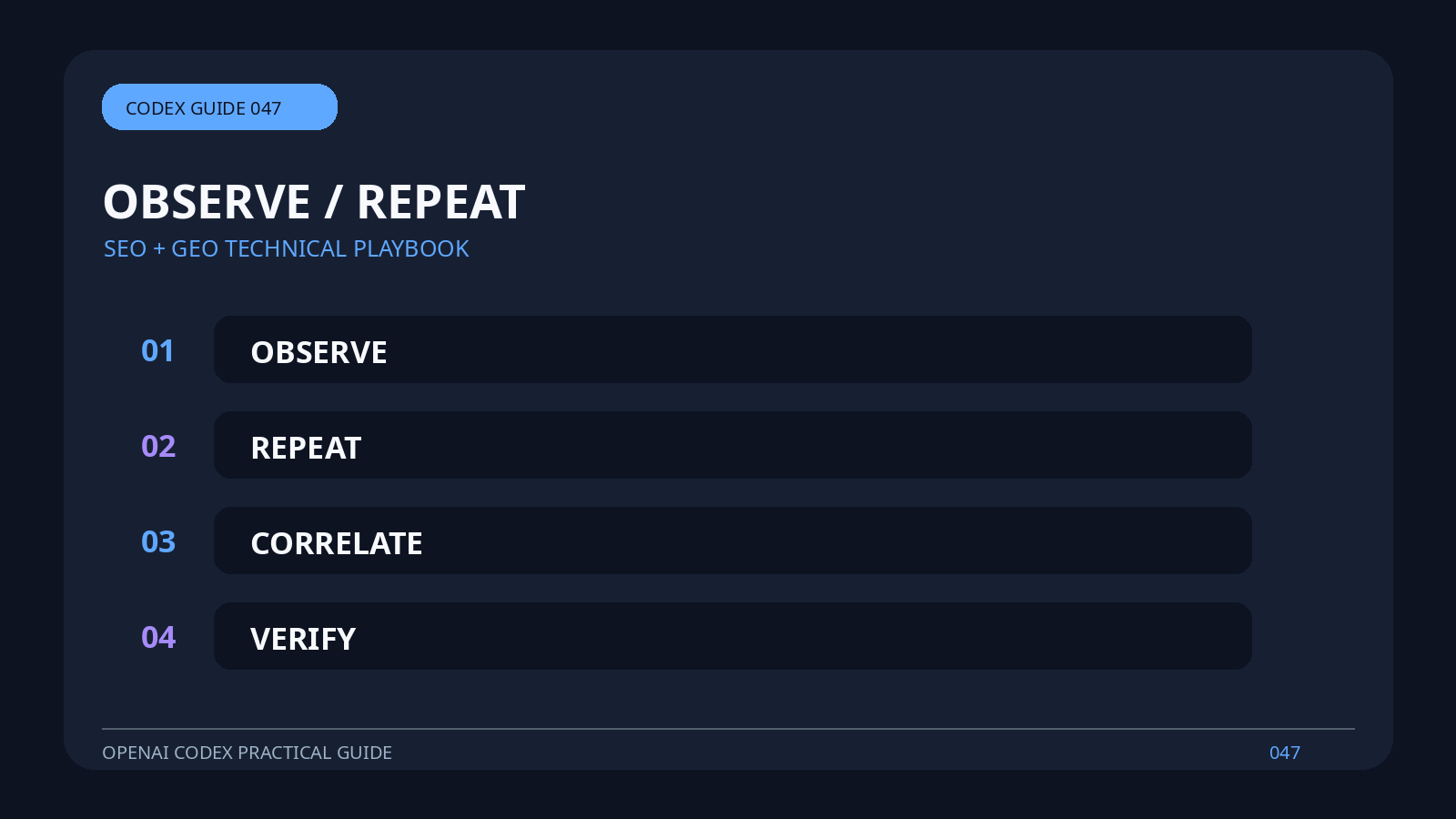
In order to enable Codex’s intermittent breakdowns to be repeated by another member, the mission record contains at least four check points: Observe, REPEAT, CORRELATE, VERIFY.
Two questions need to be answered at the same time: whether “recognition rates are recorded, time windows, resource status and repair differences”, and whether “a significant increase in logbooks without limiting sensitive information and performance costs will introduce new questions.” The former decides whether to continue, while the latter decides whether to suspend, roll back or supplement authorization.
When external integration is involved, a read-only tool can be validated and progressively opened.
It is also necessary to open the generated file, format and quantity before the final delivery.
This approach does not guarantee the same results for all projects, as a significant increase in the number of logs does not limit the cost of sensitive information and performance and introduces new issues. The conclusions should preserve the environment and the conditions of the version and provide a path to recovery.