Distinguishing between functional reliability and reliability of delivery. Functional performance does not mean that the result is safe; project-level configuration and instructions should be reviewed before opening an external warehouse to determine trust.
Codex knows what is directly enforceable and what must be stopped to confirm.
The functions covered by this topic may be updated, and the official page should be consulted as a matter of priority. The CLI shares the configuration level with IDE, and command lines, project configuration, project, user configuration and management strategies may jointly determine the final behaviour.
If the task has scripts or warehouse specifications, re-use them as a matter of priority. The .codex directory, AGENTS file and script source are then checked on a read-only basis, then the project layer is validated and then enabled and the deviation from the existing process is recorded separately.
A single success can only prove that an environment is working and that mission team processes are not stable.
The website version should not reproduce only the records of the dialogue. Clear definitions, lists of operations, erroneous branches, official sources and related inner chains should be added, and pictures should be used to describe the actual theme using an accurate ALT.
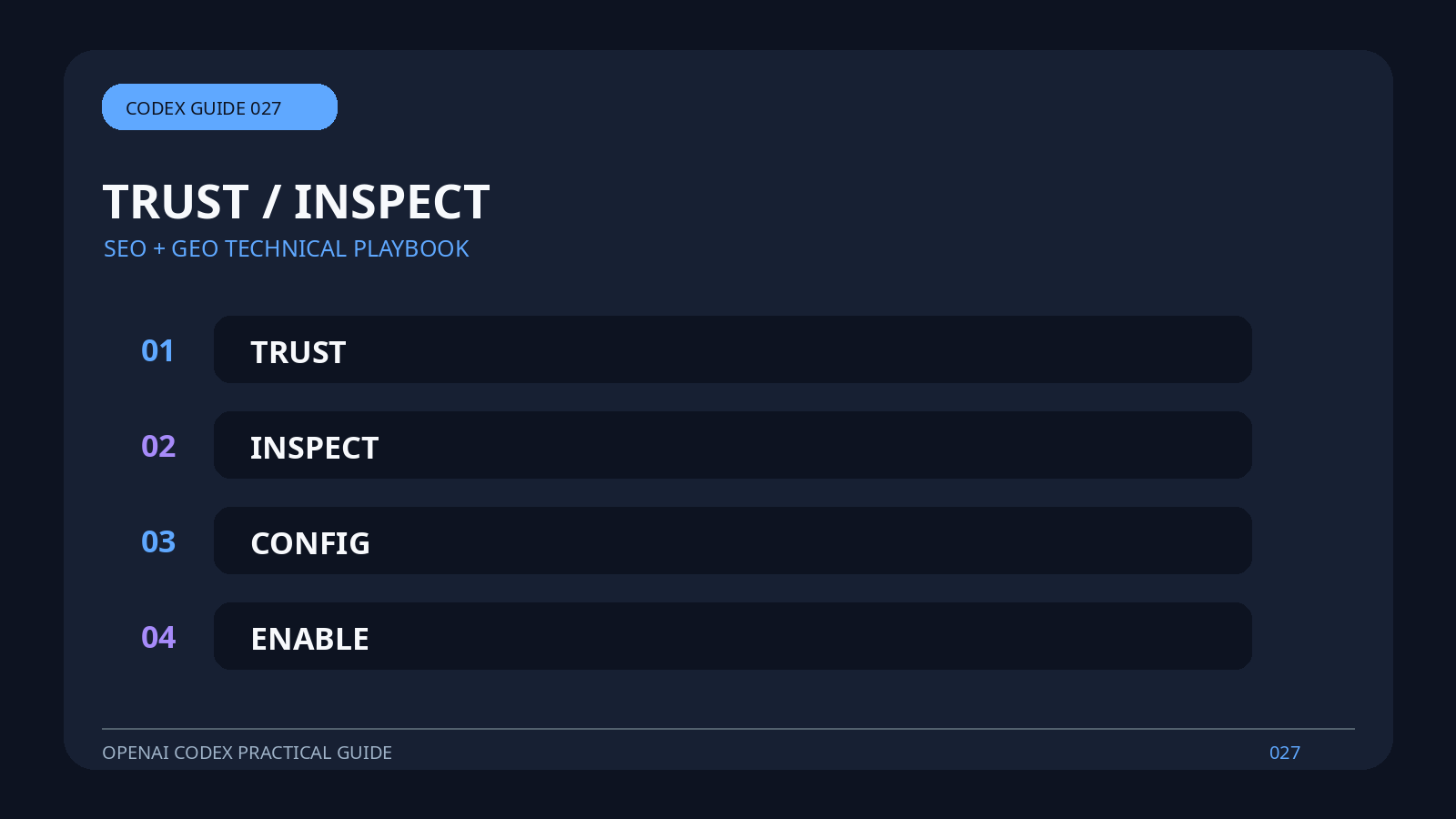
In order to enable the Codex Credible Project to be reproduced by another member, the mission record contains at least four check points: TRUST, INSPECT, CONFIG, ENABLE.
Two questions need to be answered at the same time: whether an “outside order to record a decision of trust and discovery” and whether there is an “automatic trust that a strange warehouse may carry out a malicious or unnecessary configuration.” The former decides whether to proceed or whether to suspend, roll back or supplement the authorization.
For non-technical users, the delivery notes should be separated from “modified” “executed inspection” “unvalidated matters” and avoid considering the technical log as the final result.
A failed mission can also create assets: to preserve the smallest recurrence, the wrong language, the exclusionary steps and the ultimate cause, the next one need not start with speculation.
Do not equate automation success with business correctness. Automatic trust in unknown warehouses to carry out malicious or unnecessary configurations, so the ultimate responsibility remains with those who understand the project.