
In engineering practice, the Codex configuration priority should be treated as a reviewable process, rather than as a chat. The ultimate value should be found in the error line by the actual priority instead of looking at only one file.
The reason why the topic is prone to error is that users, projects, profiles and command lines may set the same option at the same time. First, the facts, assumptions and authorizations are separated so that Codex knows what can be implemented directly and what has to stop to confirm.
OpenAI Docs provides the current boundary for this topic. The CLI shares the configuration level with IDE, and command lines, project configuration, project, user configuration and management strategies may determine the final behaviour together. The actual project still needs to be validated in conjunction with the version and organizational strategy.
It is recommended that a representative project be selected to perform exercises and not to directly cover all warehouses. This is done by checking command line coverage, then looking at project layers, programme, user layers and management strategies, and then consolidating them into norms.
The problem needs to be corrected to confirm that no side effects have been introduced. This is done by recording models, sandboxes and approval settings that are finally in effect and by checking for anomalies in adjacent modules or external systems.
When this topic is posted on the website, the title should be directed to the user question, starting with the conclusions and then writing the environment, operation, validation and restriction in the text. This is better for the search system and AI to extract the answers accurately.
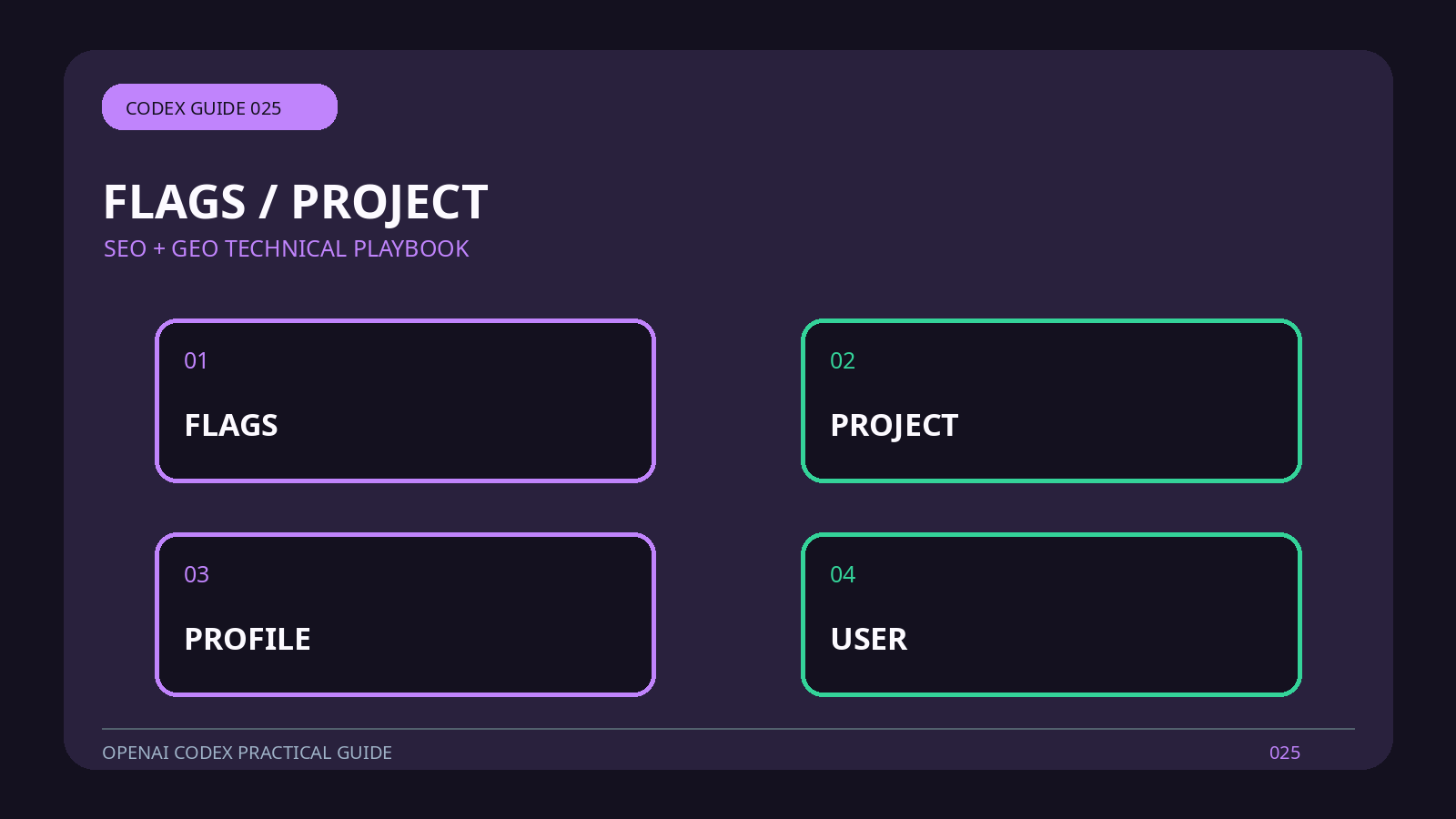
To enable Codex's configuration priorities to be reproduced by another member, the mission record contains at least four check points: FLAGS, PROJECT, PROFILE, USER. These English labels can also be used for branch, log or board search.
Two questions need to be answered at the same time: whether to “record models, sandboxes and approval settings that ultimately take effect” and whether to “modify low-priority documents that are ineffective and can be misconstrued as invalid.” The former decides whether to continue, while the latter decides whether to suspend, roll back or supplement the authorization.
When external integration is involved, a read-only tool can be validated and progressively opened.
It is also necessary to open the generated file, format and quantity before the final delivery.
This approach does not guarantee the same results for all projects, as the revision of the low-priority document is not effective and can be misconstrued as invalid. The conclusion should preserve the environment and version conditions and provide a path to recovery.