
First, it should define the final result and then add an enforcement preference. This is established, and the subsequent command, authority and certification will have a common standard.
A description of the operational process may have allowed Codex to complete the steps without creating available deliverables. Often, such deviations do not immediately cause errors, but occur during the review, testing or deployment phase of the difference, so they must be limited from the source.
OpenAI Docs recommends that the objectives, context, limitations and authentication be clearly stated; complex tasks also require clear phases, conditions of cessation and observable results.
It is recommended to make a read-only confirmation and then enter a change: write what you want to change, what you see, what you can't move, and how you accept it.
Validation can be divided into behavioral and evidence components: run the critical path, then check the output by the completion standard, rather than just respond. Neither should be declared complete.
The focus of the SEO optimization is not to repeat the Cordex keyword, but to cover the real search intent. It is recommended that URLs remain stable, that the text be synonymous to explain the problem and that links be made to the official document.
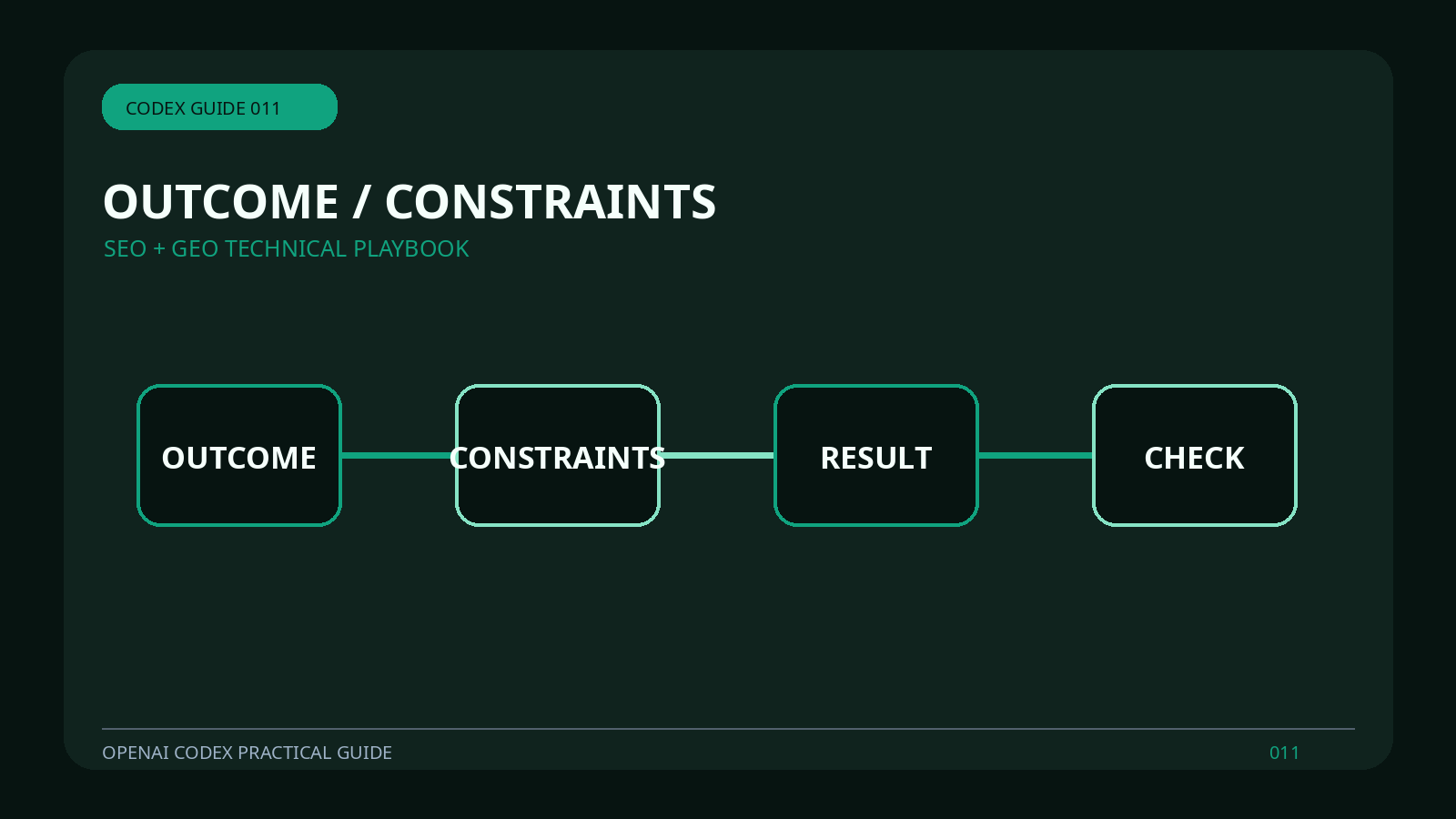
In order to enable the Codex tip target to be reproduced by another member, the mission record contains at least four check points: OUTTCOME, CONSTRAINTS, RESULT, CHECK. These are also available for branch, log or board search.
A Qualifying Repository responds to two questions at the same time: whether to “check the output on a case-by-case basis with the completion criteria, rather than simply looking at the response tone” and whether to “write the tool steps in detail and leave out the business objectives in the right form but the wrong direction.” The former decides whether to continue, while the latter decides to suspend, roll back or supplement the authorization.
For long assignments, the phasing summary should refer to actual documents and tests rather than simply describe the work done. The evidence can be reviewed more valuable than the percentage of progress.
Do not equate automation success with operational correctness. The elaboration of the tool’s steps leaves out business objectives and results in the right form but the wrong direction.