
There are no one-size-fits-all answers to such questions from the environment. For the Codex project catalogue, the reliable starting point is that the start-up location determines the context and the default range of the project that Codex can automatically discover.
The common problem is that the wrong job catalogue changes the configuration, AGENTS.md and code search range. Therefore, the target directory, the current version and the expected results are to be recorded before the start, avoiding subsequent miscalculation of environmental differences as codex capability.
The functions covered by this topic may be updated and should be given priority on the official page. The official document indicates that Codex CLI can check documents, modify codes, run installed tools in local warehouses, and access repetitious scripts and CI processes through codex exec.
This is written in a taskcard that is clearer. The card lists the object, permission, input and acceptance, and then executes the confirmation of the Git root directory and the target subdirectorie, starting and checking the status of the credible directory closest to the task.
Validation can be divided into behavioral and evidentiary components: run the critical path, then look at the identified warehouse root, current catalogue and command source. Neither should be declared complete.
The website version should not reproduce only the records of the dialogue. Clear definitions, lists of operations, erroneous branches, official sources and related inner chains should be added, and pictures should be used to describe the actual theme using an accurate ALT.
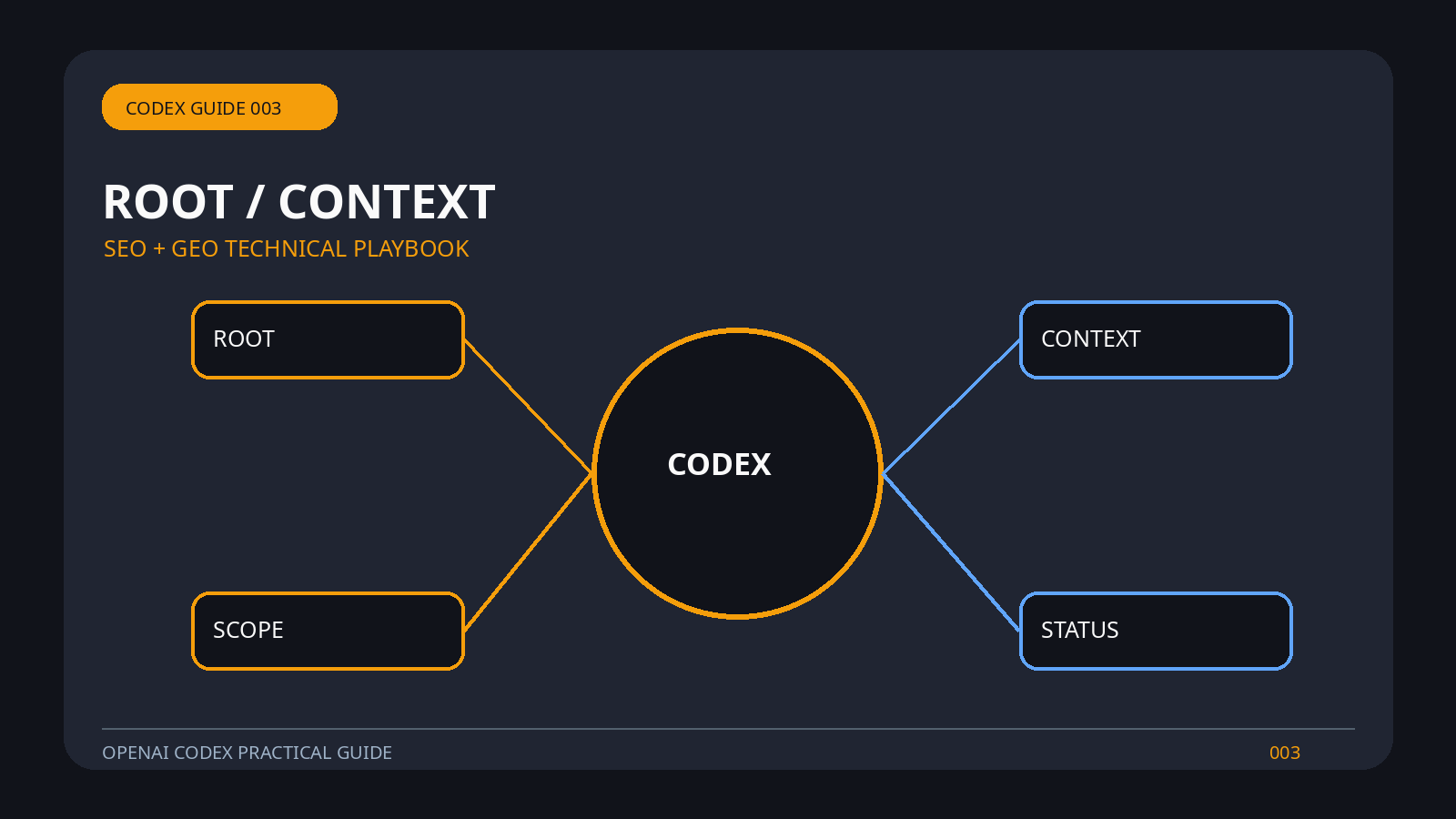
In order to enable the Codex project catalogue to be reproduced by another member, the mission record contains at least four check points: ROOT, CONTEXT, SCOPE, STATUS. These are also available for branch, log or board search.
A Qualifying Duplicate will answer two questions at the same time: whether to “see the identified root of the warehouse, the current directory and the source of the command”, and whether there is a “possible reading of unrelated documents from the start of a hyper-wide catalogue, starting from the bottom of the directory and possibly missing the root-level rule.” The former will decide whether to continue and the latter will decide whether to suspend, roll back or supplement the authorization.
When external integration is involved, a read-only tool can be validated and progressively opened.
This method does not guarantee the same results for all projects, as it is possible to read unrelated documents from the start of the hyper-wide directory, and the root-level rules from the start of the hyper-deep directory. The conclusion should preserve the environment and version conditions and provide a path to recovery.