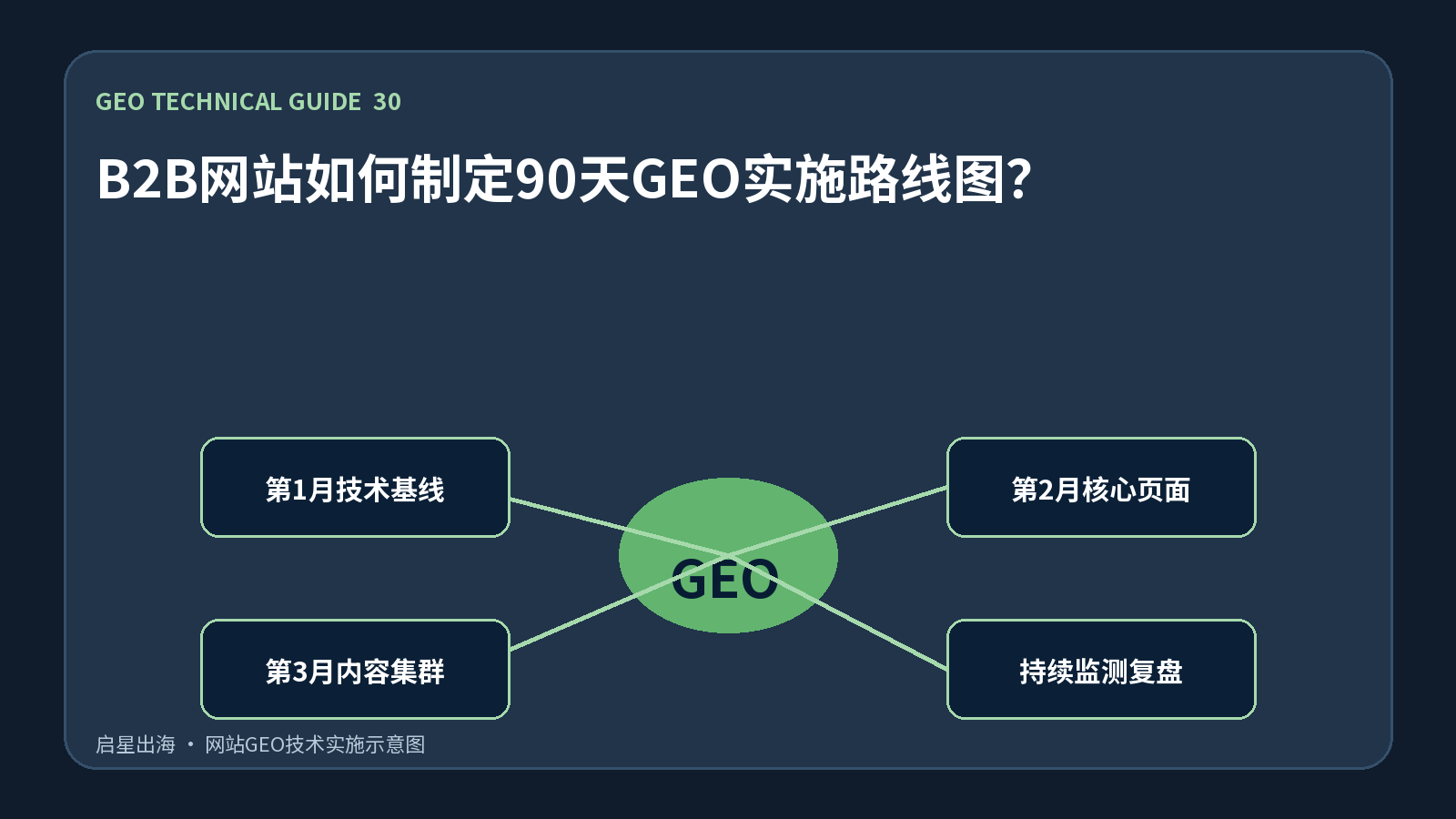
The B2B web site GEO deals with technology, content, brand, sales and data, and if all tasks are launched at the same time, it is easy for the team to complete the installation of menus and tools. The 90-day road map should first repair the problems identified, then create a credible entity and core page, and eventually expand knowledge content and monitoring. The goal is not to secure the AI recommendations within 90 days, but to establish a basic system for sustainable publication, validation and re-entry.
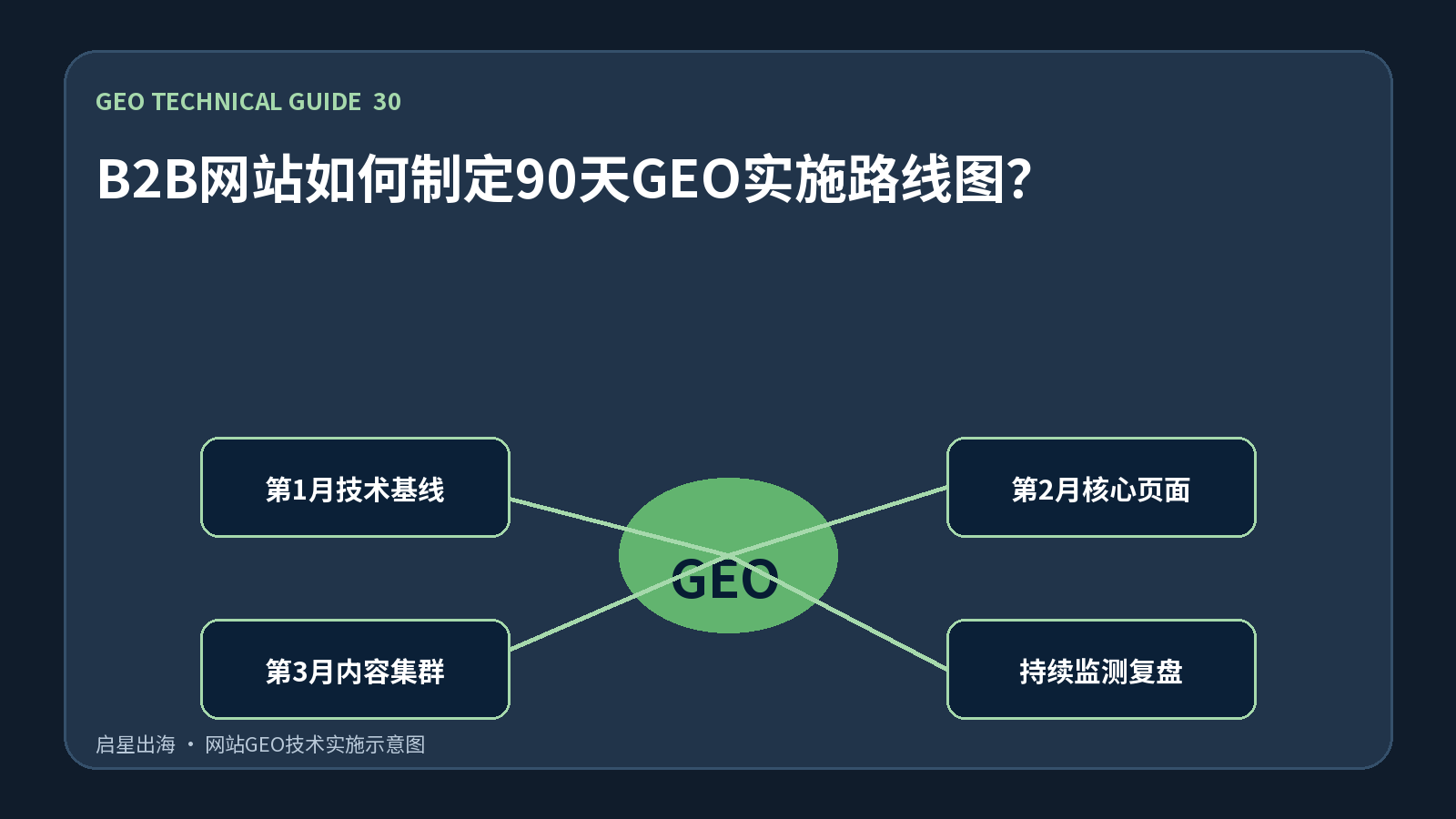
The first phase addresses accessible and data baselines, the second phase restructures the core business content, and the third phase develops thematic clusters and iterative mechanisms. The technology and content cannot be fully synchronized: the template can be repaired in tandem with the preparation of the business fact sheets and product data dictionary.
Completion of full-stop capture, indexing and URL audits in 1st to 30th days, repairing 5x, error robots, Canonical conflicts, duplicate navigation and Sitemap questions; establishment of a baseline of business fact sheets, target client lists and indicators. Optimizing the front page of 31st to 60th days, on linkages, core product and service pages, with additional parameters, cases, authors and corresponding Schema, to improve the multilingual mapping.
The road map must designate technical, content, professional examiner and data manager.
The common error is that hundreds of articles are generated in bulk during the first week, all jobs are handed over to SEO plugins, no sales team is involved in the sorting of issues, or one brand is mentioned as a success. GEO construction should be based on real business facts, with a continuous accumulation of accessible, verifiable, and reuseable content assets.
The “January technical baseline, February core page, March content cluster, ongoing monitoring retrodiscussion” should be included in the same release checklist, specifying the content manager, technical manager and date of review. Any change must be accompanied by a check of the visible content of the page, HTML source code, structured data, internal links and site maps, so as to avoid that the front desk has been updated and the machine reading layer retains its old values. GEO is not a one-time plugin and does not guarantee that any platform will be quoted; it is a set of content and technical engineering that continuously improves the accessibility, validation, attribution and citation of information.