When you have a problem with YouTube multilingual titles, do not rush to copy hot channels.
A more economical way to return to work is to check the local search results against the client’s words, then translate the entity, condition, and action expression, and be reviewed by the mother tongue.
Word-to-word translation ignores local calls, units and search habits. When samples are scarce, the deviation is magnified by random fluctuations in a single video.
YouTube offers multilingual skills such as translation titles and descriptions. Tools can store localized metadata, but they cannot be a substitute for local word studies, mother tongue reviews, and market differences.
Sets its own baseline for this topic and looks at the words click, view and comment by language to see if it attracts the right audience.
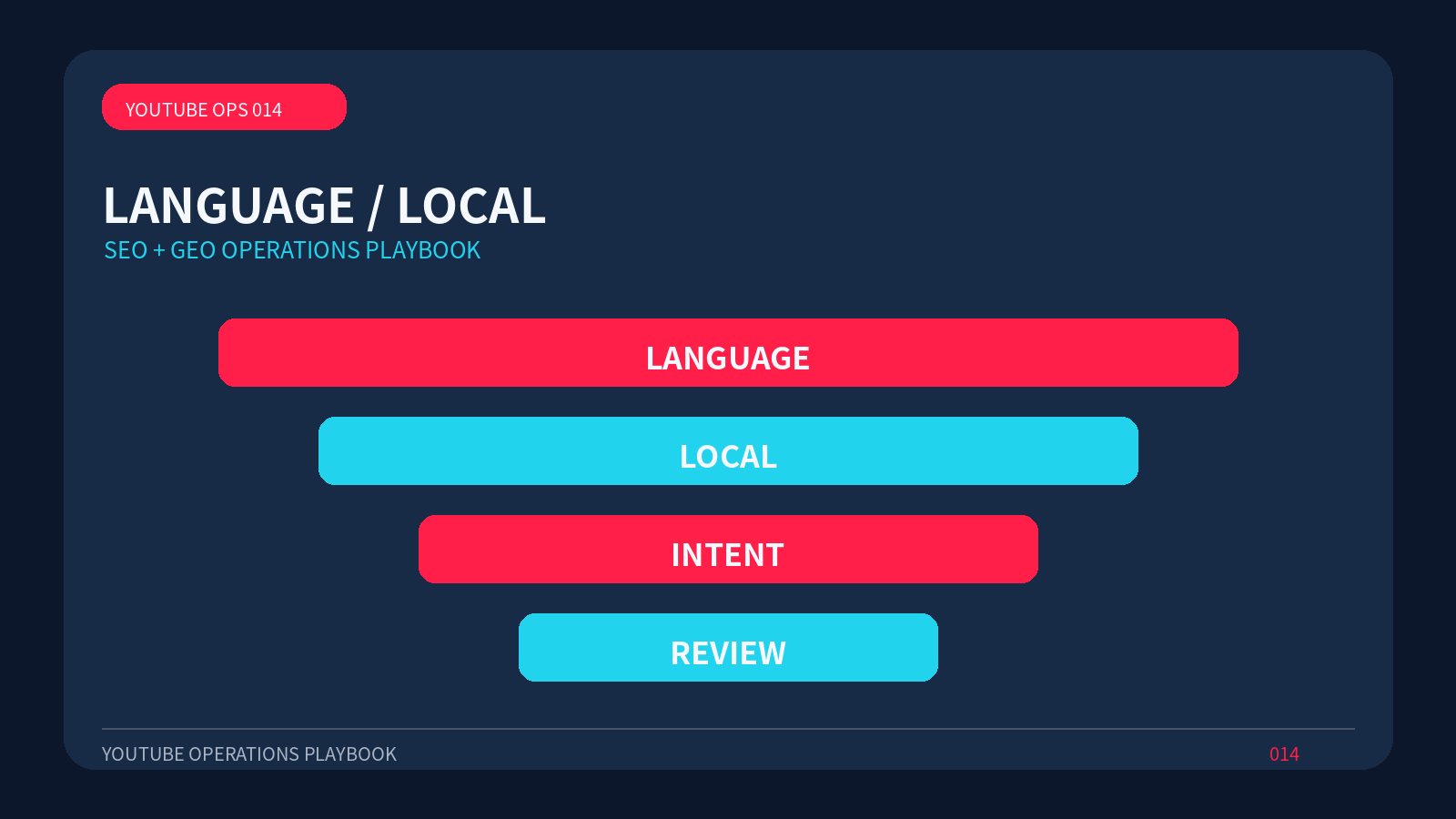
In order for YouTube's multilingual titles to be reproduced, the project records should include the target market, the material version, the release time and four check points: LANGUAGE, LOCAL, INTENT, REVIEW.
In order for the search engine and the AI system to understand it accurately, the video could be organized into a stand-alone web page, which would correct the entities and numbers in the text and complement official sources, author information, photoalt and related inner links.
Without this information, it is difficult for follow-up staff to judge whether the content is still available.
Pre-production may be preceded by a list of “must” and “not”. The former includes key evidence and limitations, while the latter includes customer privacy, unauthorized assets and unproven commitments.
The content requires a complete service task. If the user is to compare, install, type or request, the page should provide the information necessary to perform the task, rather than deliberately breaking the answer.
The risk of being most easily overlooked is the mass release of mechanical translations, which can easily produce hard promises and wrong intentions. Short-term figures may still rise, but problems can be exposed during the security phase of the complaint, sale or account.