Many errors are not that the tool will not be used, but that the objective is not defined. When dealing with the subject, the keyword study should start with the user ' s mission and problem, and then the search results should validate the intent.
The common bias is that relying solely on search volume tools leaves out the real language used by users in comments, customers and sales. This allows the team to attribute the results to the platform without checking the consistency of content commitments, audiences and conditions of implementation.
A more economical way to return to work is to collect search proposals, comments, website queries and client questions, grouped by entry, comparison, operation and failure.
The acceptance and inspection criteria should preferably be completed before they are issued: check the search terms actually obtained by the video, view quality and follow-up.
The platform’s public information can confirm the basic conditions, not the secret to securing the results. YouTube’s public description of the search and discovery emphasizes that the system wants the audience to find what they want to see and to be satisfied with; search matching, viewing behavior and personalization need to be understood together and cannot be reduced to a mysterious weight.
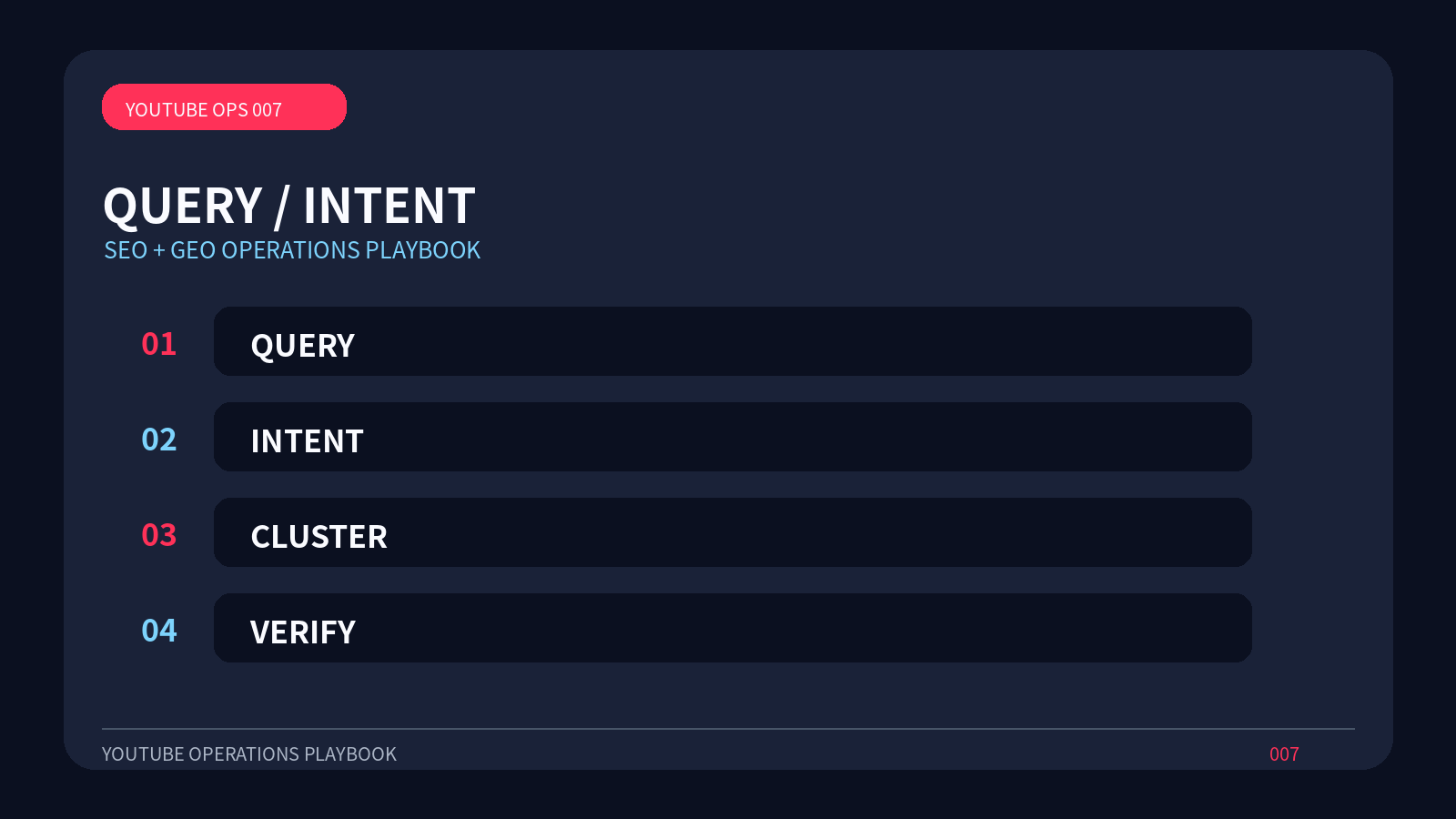
In order for the YouTube keyword study to be reproduced, the project record should include the target market, the material version, the release time, and four check points: QUERY, INTENT, CLUSTER, VERIFY. These English labels can also be used directly in the cross-linguistic material library.
Do not write correlation directly into cause and effect. Put the high-heat word hard on irrelevant content, leading to false clicks and quick exits. The conclusion is worth expanding only if similar samples, stable calibres and real feedback are supported.
When the data are insufficient, the channel’s own normal space is created.
When you refer to data, you must save the original report, the filter conditions and the date of the view.
Videos, subtitles and web pages should have a consistent entity name, but do not need to be copied word for word.