The real difficulty is not to know a technique, but to know when it works. For TikTok material copyright, it is necessary to confirm the authorized range of videos, pictures, music, fonts and portraits of people.
From a user's point of view, public visibility does not mean that it can be reproduced, edited or used for commercial dissemination. Content must be understood independently by people who are not familiar with the brand, and cannot depend on the background that is known to an internal person.
The platform’s public information provides a boundary for this topic. The commercial content should be preceded by a confirmation of the authorized range, with the brand account giving priority to TikTok Commercial Music library, and maintaining the source and licence records of the material.
The recommendations are prioritized: first, to ensure that the facts and authority are correct, then to record the origin, duration and region using original or clearly authorized material; and, lastly, to comply with applicable law and assess risks when citing the necessary elements, to optimize packaging.
During this period, a list of rights should be reviewed prior to publication, complaints received should be kept and processed in a timely manner and anomalies and changes in platform configuration should be included in the notes.
The off-site page uses entity names and core terms that are consistent with the video, while providing access to the body text, pictures, ALTs, related inner links and URLs; this is more conducive to long-term search than the stacking of words such as “TikTok SEO”.
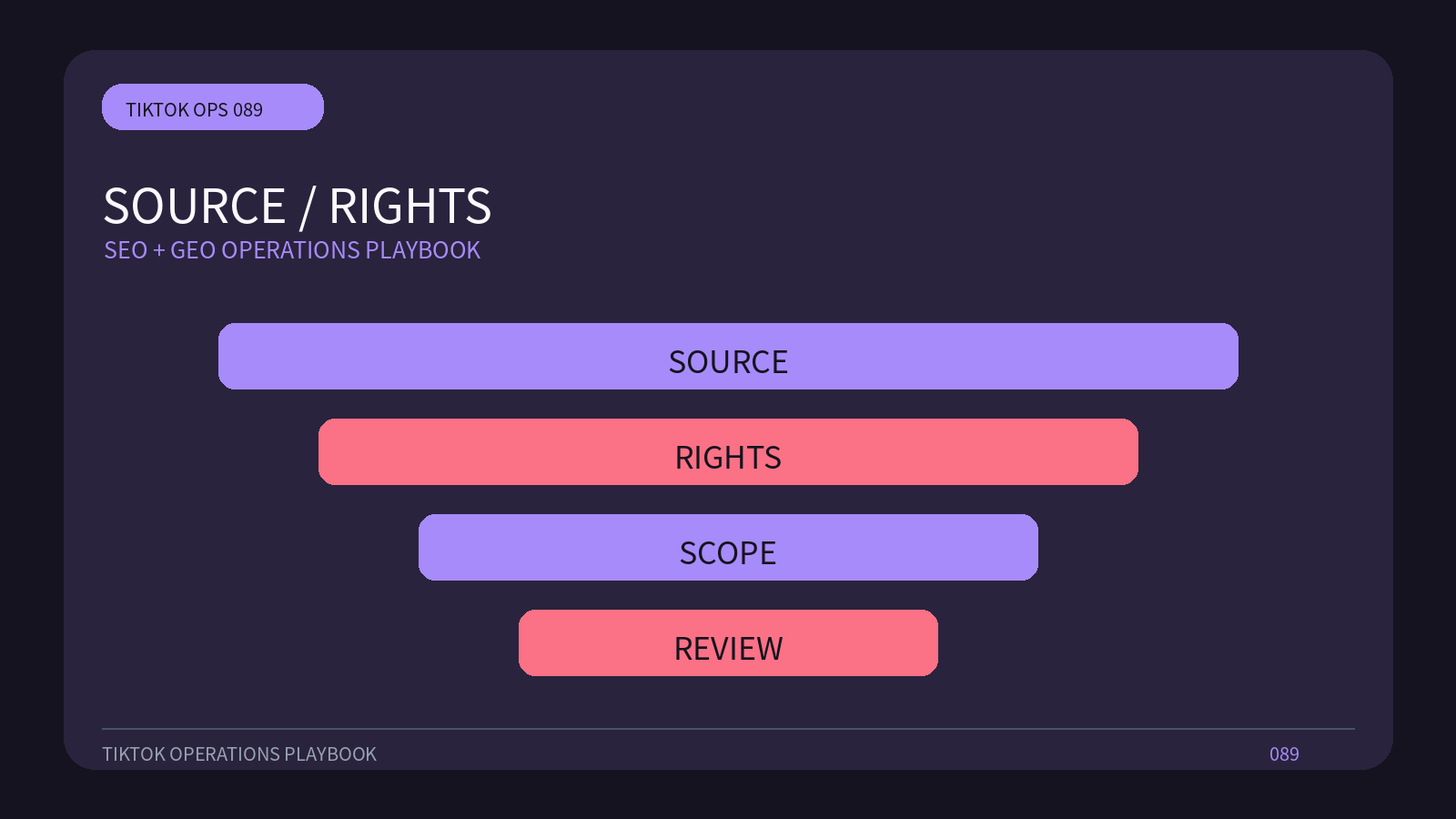
In order to allow TikTok copyrights to be reproduced, the project records must contain at least the number of the material, the time of publication, the target market and four check points: SOURCE, RIGHTS, SCOPE, REVIEW.
There are also two questions to be answered at the same time: whether “the list of rights is reviewed prior to publication, and the complaint is promptly preserved and processed”, and whether “the right of access will not be automatically acquired by removing the watermark, changing the speed or intercepting for a few seconds.” The former decides whether to continue, while the latter decides whether a suspension, correction or additional explanation is required.
What needs to be specifically avoided is that the right to use is not automatically acquired by removing the watermark, changing the speed or intercepting for a few seconds. If a particular information cannot be publicly verified, the source, scope of application or uncertainty is clearly stated, and no speculation is packaged into platform rules.