If there is only one principle to remember, it is that the event should be a real business step and be consistent with the definition of the website and the CRM. It helps the team to turn "favourable" into a resetable implementation.
The most diagnostic signal of the topic is that “the complete funnel analysis cannot be supported by the installation of basic access events alone, with too many incidents generating noise.” It suggests that the team needs to return to the user's mission and confirm who the video actually helped to make the judgement.
The TikTok Advertising Centre’s description of the configuration is suitable for checking product functions; the actual placement should also record the version, region, budget, event calibre and attribution window.
A more secure way to land is to chart access, view content, submit threads, purchase, etc., set standards or custom events to test weights and parameters. Do not redo all content at once; select three or five of the same audience for testing, confirm direction and then expand the series.
It is proposed to establish a simple baseline for this topic and cross-check events with test tools, browsers and back-office orders.
GEO Optimization focuses on citation: conclusions are understood in isolation from context, data are calibrated and experience indicates scope of application. AI can summarize content but should not substitute for factual verification.
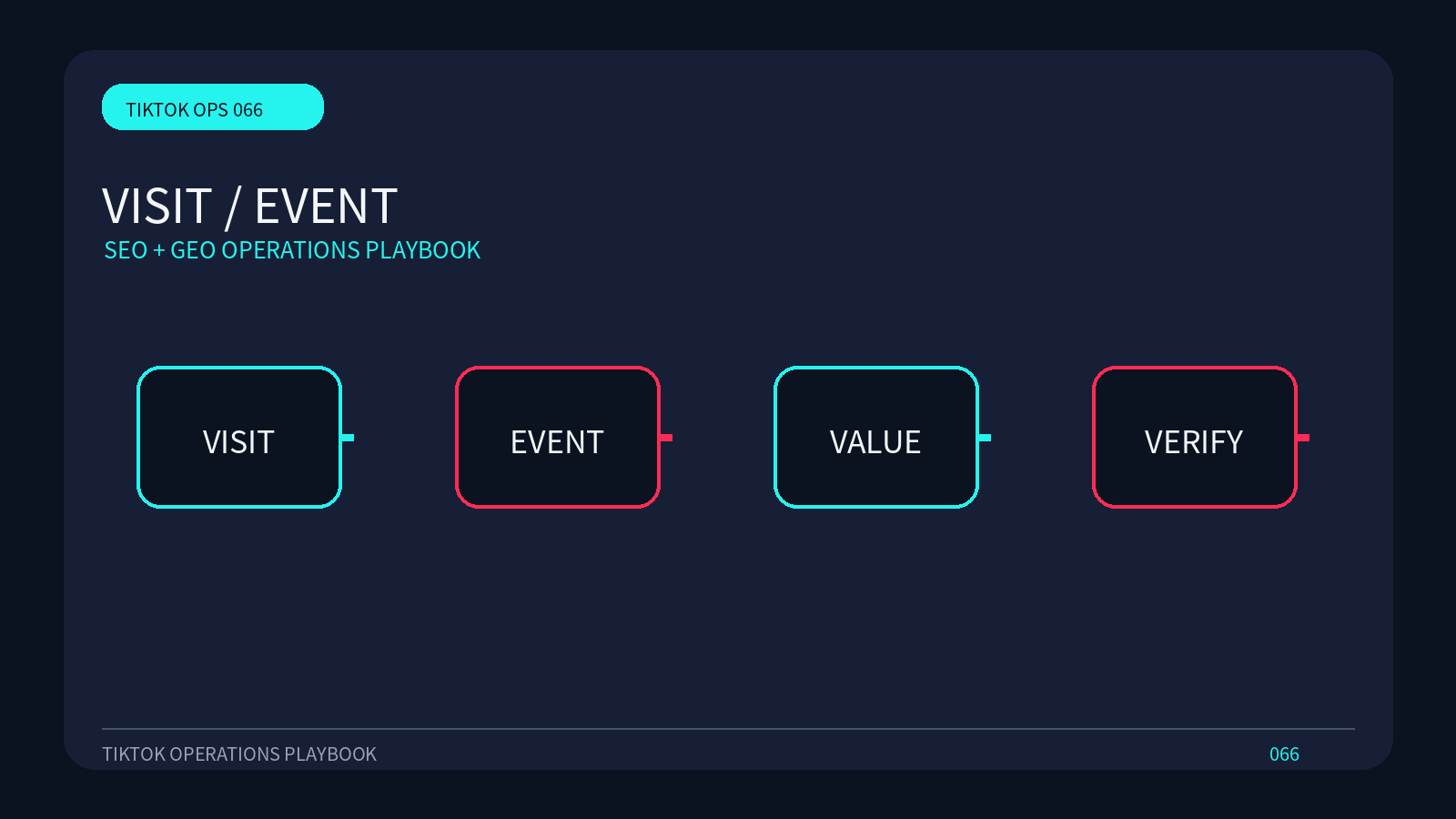
In order for the TikTok Pixel event to be repeated, the project record must contain at least a reference number, release time, target market and four check points: VISIT, EVENT, VALUE, VERIFY.
Two questions are also answered at the same time: whether “the number and value of events are cross-checked with testing tools, browsers and back-office orders” and whether “a repetition of triggers, erroneous amounts and a refreshing of the thanks page would allow for optimization and attribution to be distorted.” The former decides whether to continue, while the latter decides whether a suspension, correction or additional explanation is required.
The scope of application needs to be publicly stated, because the repetition of triggers, erroneous amounts, and an update of the thanks page would render optimization and attribution distorted. Experience with the establishment of a particular market or account should not be written directly into the rules that all must follow.