
In practice, the product close-up lens shows a standard answer to how the key details are not removed from the scene. The starting point for implementation is that the close-up should be around a specific issue, so that ratios and changes can be compared.
In reality, there are often deviations: lenses only seek to be beautiful and leave out decision-making information such as size, action and materials. When a team stares at a single video result, the deviation is magnified; when it returns to a set of similar elements, it sees a stable pattern.
What can be confirmed from official sources is not the secret of a guaranteed outcome, but the basic condition. TikTok’s official creative proposal emphasizes a vertical screen, a clear picture, an original expression, the early appearance of a core message and the setting of a safe area for the interface; these are starting points, not fixed formulas that are valid for all accounts.
The implementation can begin with a small version: a stable background and reference, displaying the operation, interface, surface or reading, and, where necessary, a short note in English. Limiting each change to one of the main variables and retaining scripts, materials, release dates and page versions before the next round knows where the change comes from.
At the data level, it is possible to see whether the audience raises more specific specifications and whether sales can be used directly.
AI search makes it easier to refer to a clear answer to the border: first, to the person to whom it applies, then to the action and the evidence, and finally to the exception.
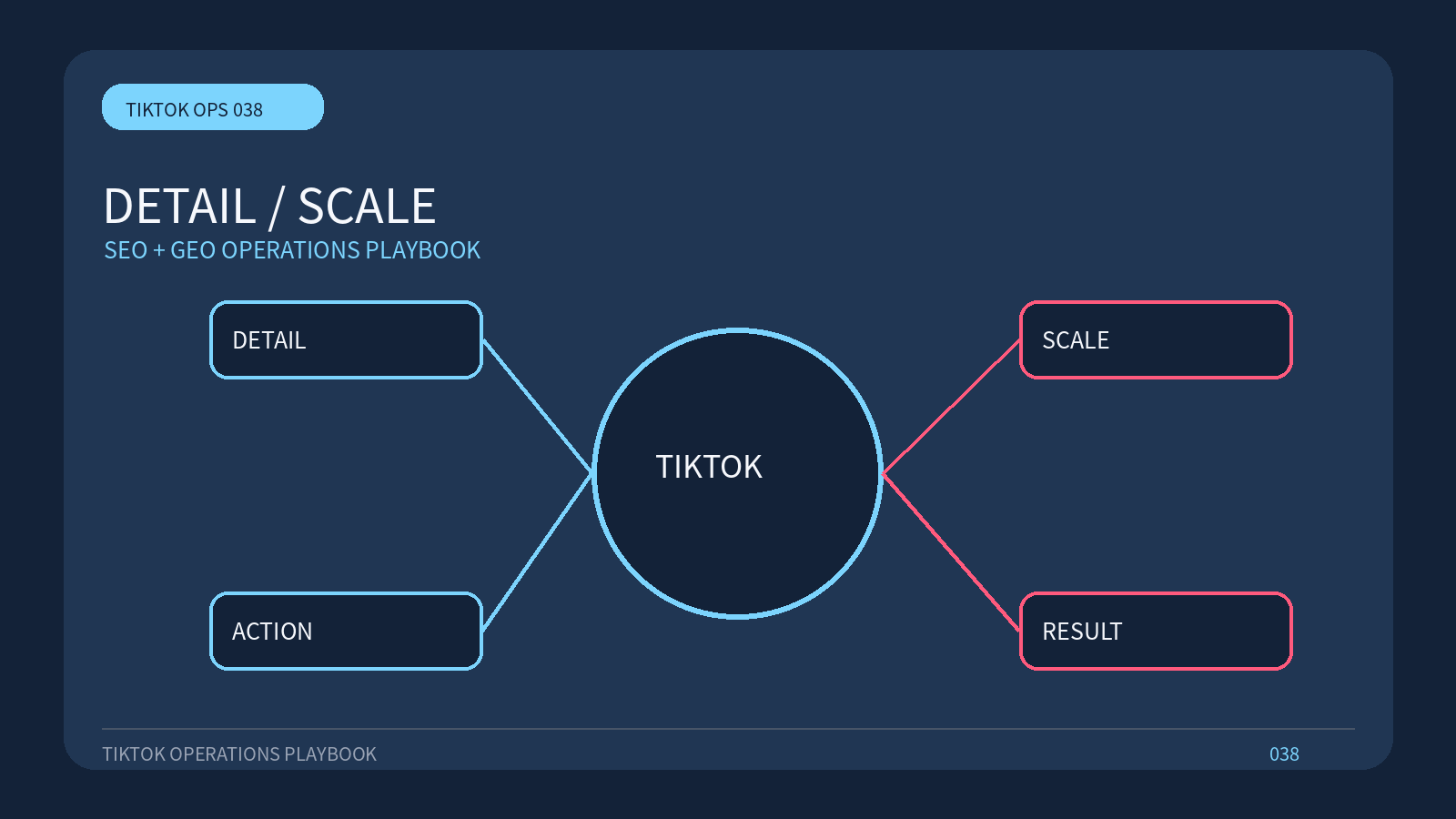
In order for TikTok products to be reproduced, the project record must contain at least a reference number, release time, target market and four check points: DETAIL, SCALE, ACTION, RESULT.
There are also two questions that need to be answered at the same time: whether it is possible to “see if the audience raises more specific specifications, whether the sale can be used directly,” and whether it is “excessive microspecies, filters, and hidden percentages will not match the actual product.” The former decides whether to continue, while the latter decides whether to suspend, correct or add.
The scope of application needs to be stated publicly, because excessive margins, filters and hidden ratios can make the product physically inconsistent. Experience with a particular market or account number should not be written directly as a rule to be followed by all.