
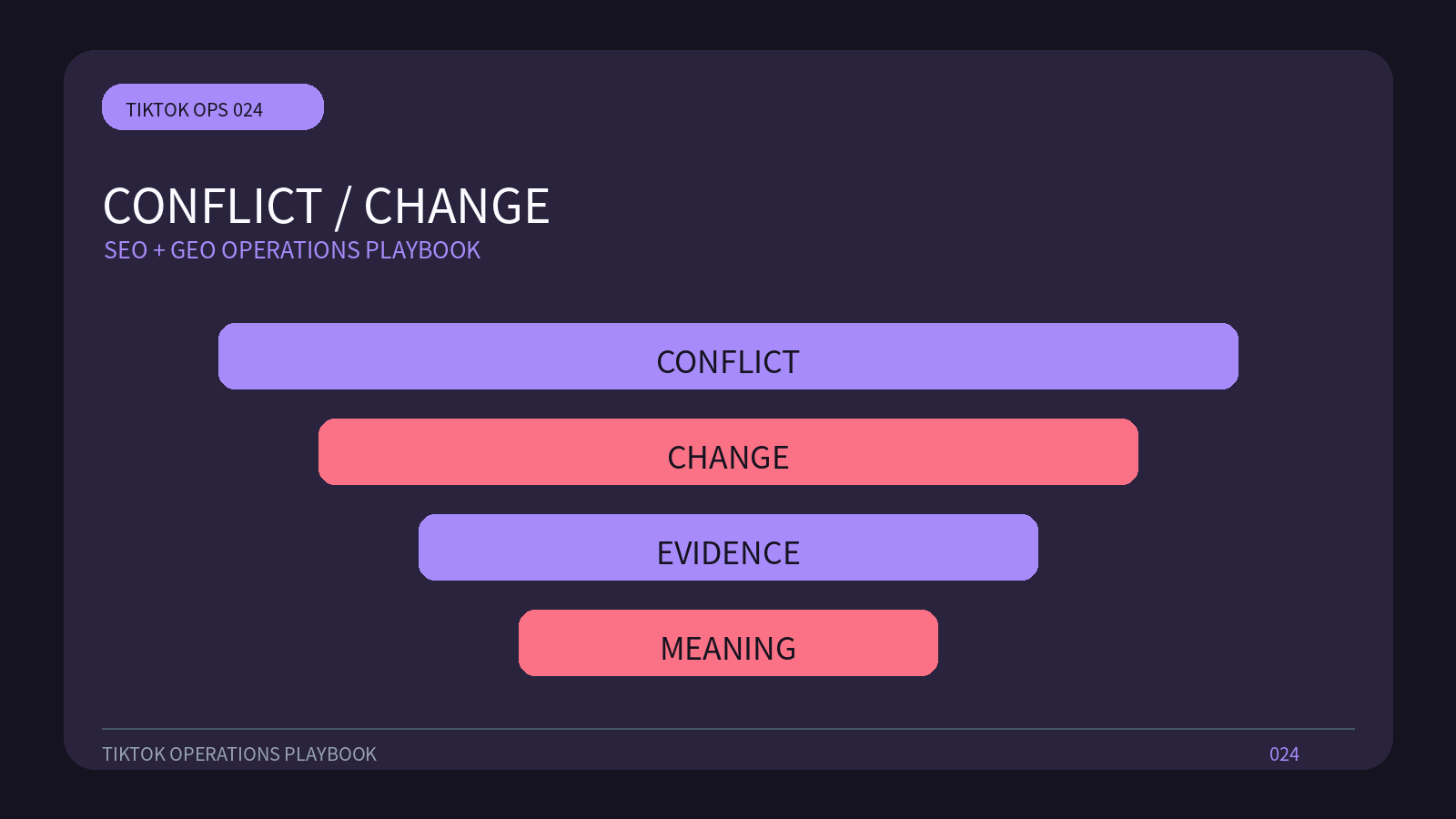
Many of the teams will start in form, and the order should be the other way around. For TikTok’s story structure, a conflict or target is given at the beginning, with only the details of the push-out and the end meaning, otherwise the data will be difficult to explain.
It is easy to make mistakes because the story is organized around a change and result rather than a time stream. The solution is to separate the facts of the content from the operating assumption: the former needs to be checked and the latter needs to be validated through a continuous sample.
The public basis of TikTok's story structure can be consulted: TikTok's official creative proposal emphasizes vertical screens, clear graphics, original expression, early availability of core information and reservation of safe areas for interfaces; these are starting points, not fixed formulas that are valid for all accounts.
The minimum available version is completed when you land: write a change and select the lens necessary to cut the clips in a sequence of cause and effect rather than in time, and delete paragraphs that do not affect understanding. The second person examines the information gap from the point of view of the target user before posting, so that the producer does not lose sight of the information gap because he/she is familiar with the content.
It is suggested that a simple baseline be established for this topic, and that the clarity of the story be judged in the context of retaining drop points, restatements of comments and reasons for sharing.
When video rules or interfaces are subject to change, the page should display the date of review and link to official information. This allows users and AI to distinguish between long-term methods and changes in the operation of the version.
In order for TikTok’s story structure to be reproduced, the project record must contain at least a reference number, release time, target market and four check points: CONFLICT, CHANGE, EVIDENCE, MEANING.
There are also two questions that need to be answered at the same time: whether to “retain drop points, comment on restatements and share reasons to determine whether the story is clear” and whether there is “a deliberate extension of the pavement in pursuit of a long period of time that will allow the audience to leave before the information appears.” The former decides whether to continue, while the latter decides whether a pause, error or additional explanation is required.
When it comes to copyright, privacy, price, performance promise, or industry regulation, it should be subject to review by the person in charge.