
To solve the question "Whether the instant form or the independent website landing page is more suitable for LinkedIn advertising?", the first step is not to find skills, but to eliminate wrong assumptions.The team may well interpret the problem as a lack of traffic, but the real reason is that only submission costs are compared, ignoring information depth, website trust, tracking capabilities and sales screening needs.The two judgments lead to completely different actions.
Start by sampling recent content, interactors, or leads to answer three things: are they your target customers, do they understand your value, and are the next steps clear enough.LinkedIn advertising must first clarify funnel goals, data sources and sales definitions; if tracking and undertaking are incomplete, the platform cost will not be able to prove the business value no matter how beautiful it is.If you cannot answer one of the three items, it means that the foundation of advertising still needs to be reconstructed.
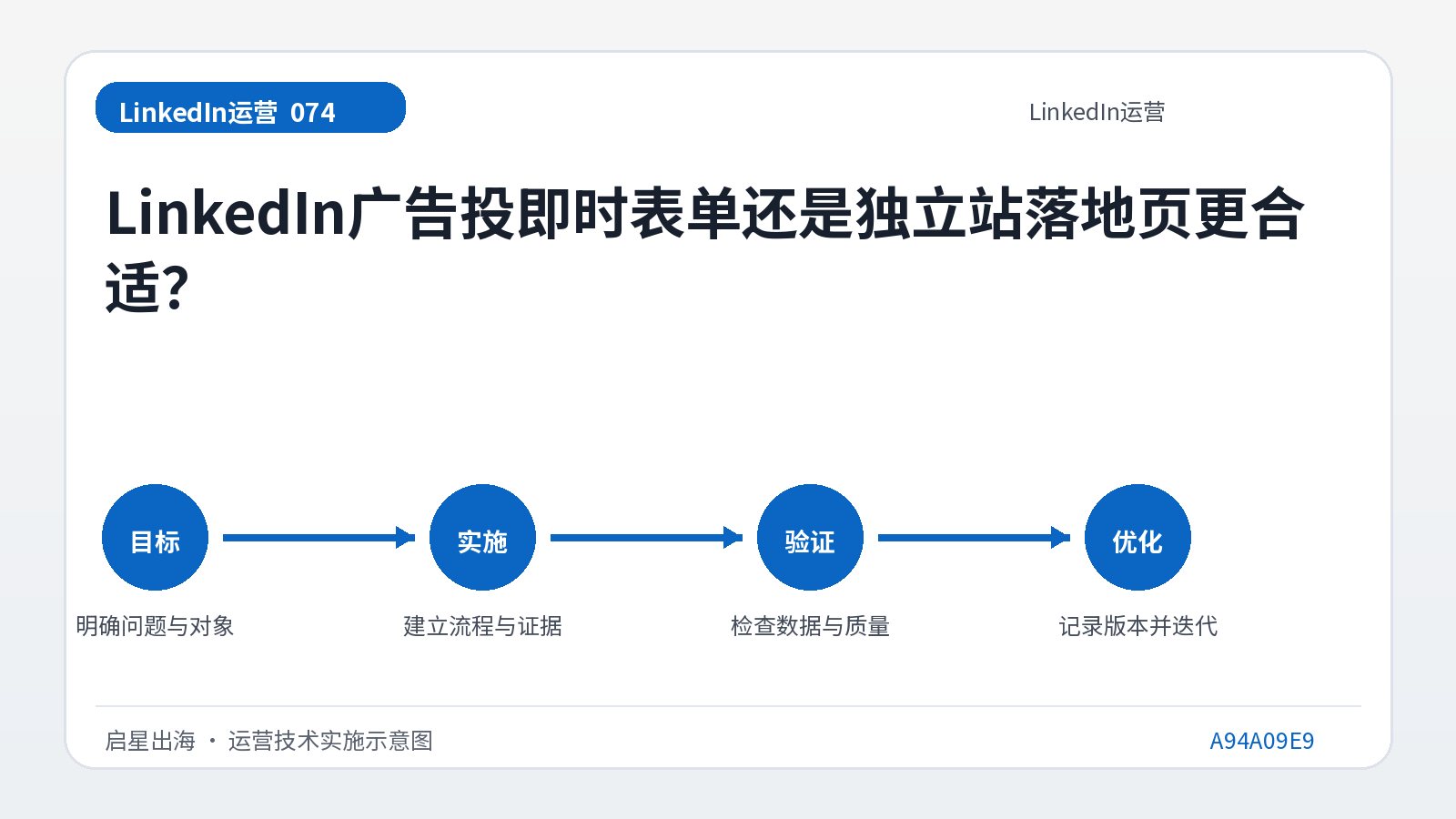
Prioritize execution: Get low-friction data and test the Lead Gen Form. For complex plans and high-intention conversions, use professional landing pages and compare them.At the same time, confirm the ad account and homepage permissions, Campaign Group and naming, marketing goals, conversion events, Insight Tag, UTM, landing page or form, CRM and sales response in sequence.order, do not skip the previous positioning and evidence and directly pursue the final inquiry.Only test one key difference in each round and set stopping conditions to avoid constantly adding resources without reaching a conclusion.
Evaluation metrics are divided into two categories: leading and results.The leading indicators are delivery status, clicks, landing page behavior, form completion, effective lead rate, sales acceptance rate, opportunity cost and attribution completeness, and the result indicators are effective leads, quotes and business opportunities.This question involves comparing completion rate, effectiveness, business opportunity rate and follow-up speed.Only when the two types of indicators are in the same direction can the changes be truly effective.
A common misconception is to immediately amplify when you see a drop in costs or an increase in engagement.The B2B sample is small, so customer identity and needs should be verified first, and then a stable period should be observed.Results that can be used by sales, can be followed up, and can be traced to their source are results worth retaining.
When implementing this question, you can first use a small group of real target accounts to verify: low-friction data acquisition can test the Lead Gen Form, and complex solutions and high-intent conversions can be compared with professional landing pages.After execution, don’t just judge based on your feelings, but compare the completion rate, efficiency, business opportunity rate and follow-up speed; at the same time, save the customer identity, version, date and subsequent sales results to avoid mistaking accidental replies for replicable methods.



