Many errors are not that the tool will not be used, but the target is not defined.
On the surface is an operational detail, and the problem behind it is that elements may exceed the allowed time, are not compatible with the length of the video or are limited in part of the scene.
When you land, it is recommended that you make small-scale samples: set the image space in the last paragraph, confirm the element time and target to be valid, and then test it with the desktop and mobile phone.
The effects are judged by looking at the end-of-view display, clicks, and different devices.
The platform’s public information can confirm the basics, not the secret to ensuring results. Google’s guidance on helpful content emphasizes a real audience, demonstrates direct experience and provides credible information. Search optimization cannot replace actual value by batch rewrite and keyword repetition.
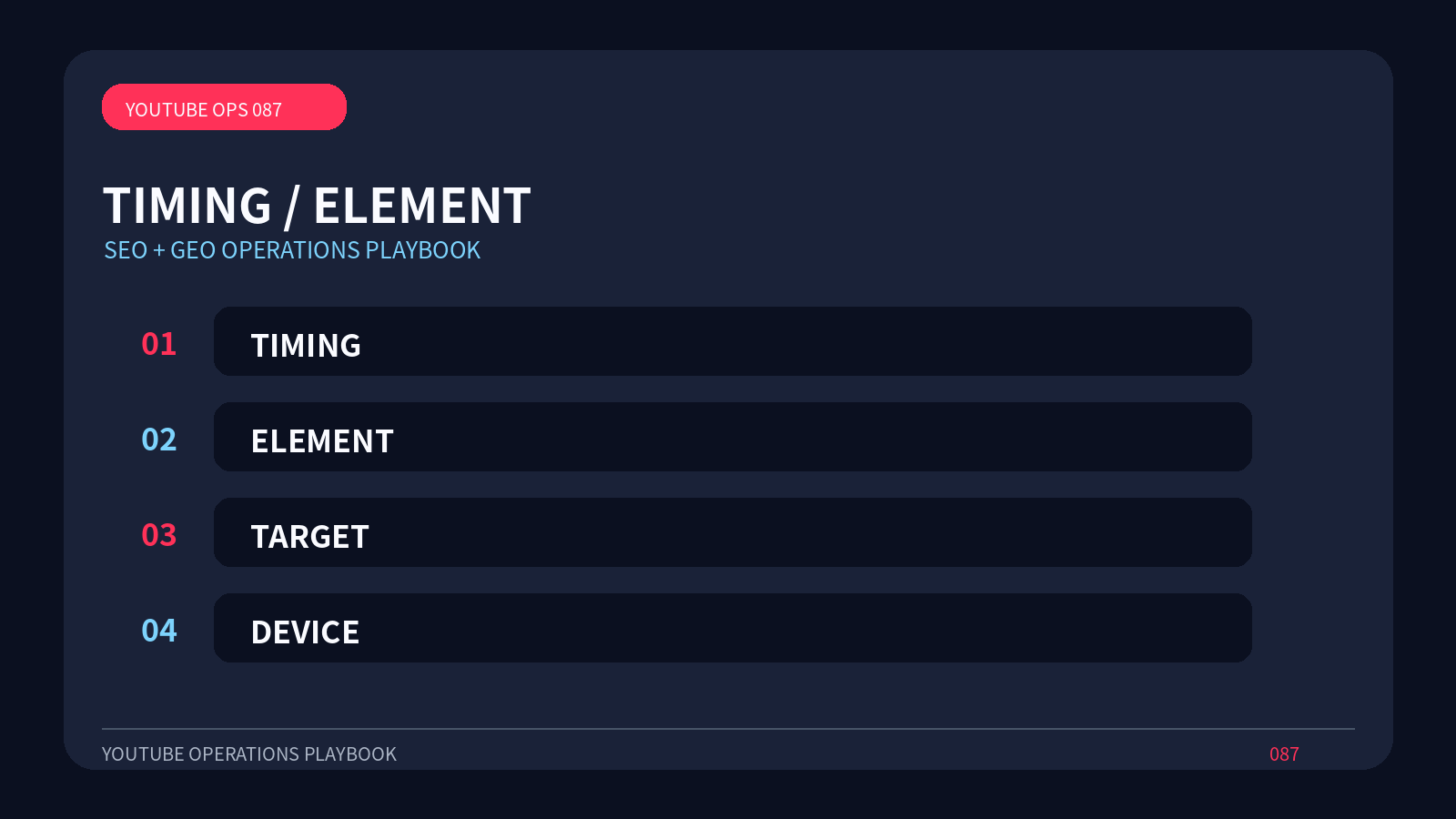
In order for YouTube's end-screening to be available again, the project records should include the target market, the material version, the release time and four check points: Timing, ELEMENT, TARGET, DEVICE.
This approach does not guarantee an increase in traffic. By placing the key actions on an end-of-the-art picture and losing the audience who left early, the rules, the error correction and the rollback are to be preserved with the test.
Commenting on the original text reveals how the user describes the problem. The next article can follow the true expression, but the removal of personal data cannot be considered a general conclusion.
The technical content distinguishes between presentation and proof. The picture can help understand, but it is not necessarily sufficient to support performance conclusions; test conditions, samples and source information should be supplemented as necessary.
Search optimization does not duplicate words such as “youtube operations”. Natural writing of brands, products, areas, roles and problems is more conducive to establishing physical relationships than stacking keywords.