If you have a problem getting ready for YouTube live, do not rush to copy a hot channel.
Write the action as a tickable checker: test the upload bandwidth, encoder, resolution, audio, image, chat and playback settings to save the check results. Each completed item should correspond to the file, image, text or background record.
In reality, resistance usually comes from a network, code, audio, permission or delay. Any error in setting up can undermine live broadcasting. It may continue to be transmitted to websites, sales, guest clothes or copyright processing.
From an official point of view, some common misunderstandings can be eliminated. Live quality depends on both web upload, encoder, audio, delay and platform status.
The effects are judged by recording the frame, delay, volume, failure recovery time and audience feedback.
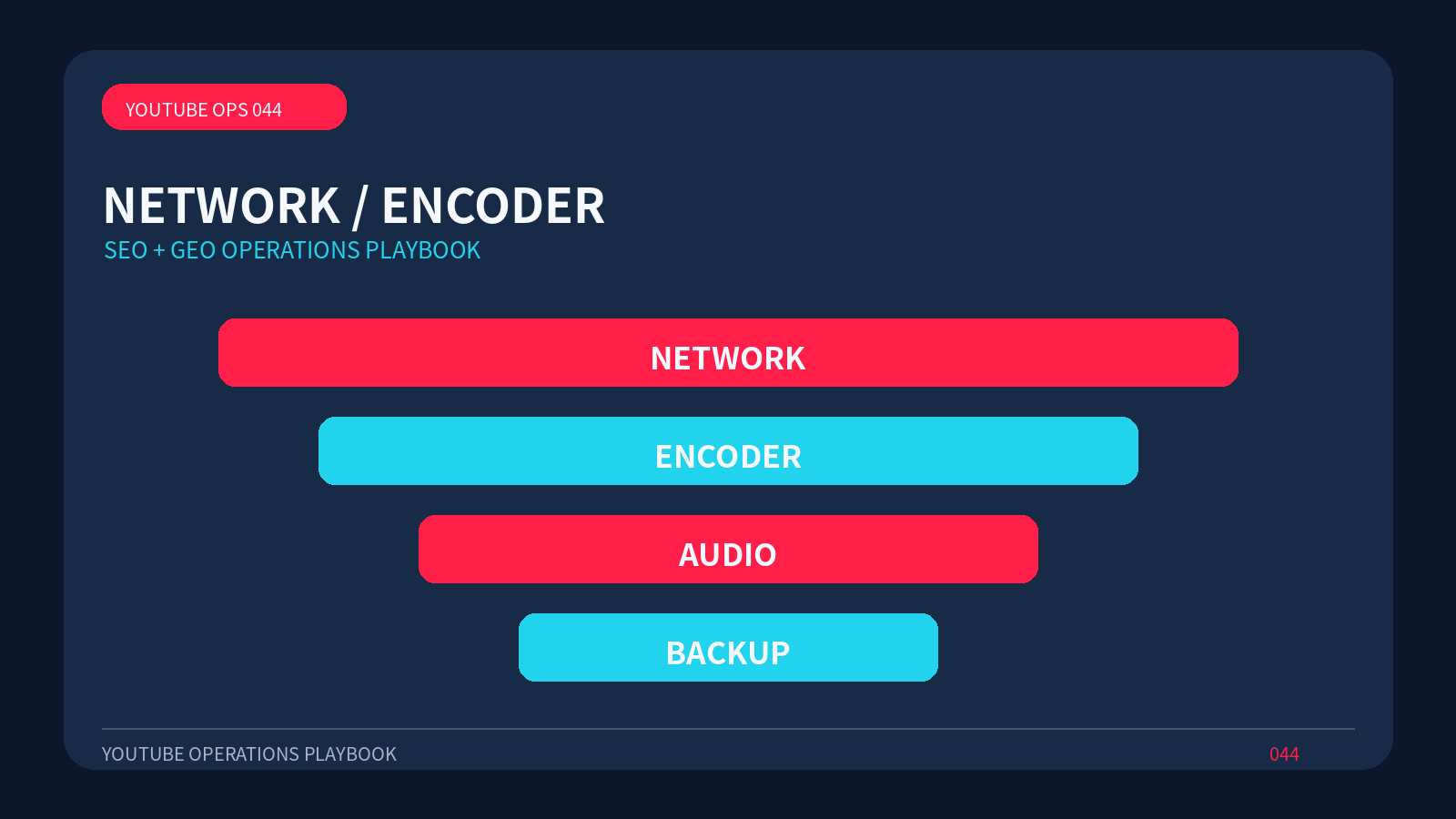
In order for YouTube to be ready for live appearance, the project records should include the target market, the material version, the release time and four check points: NETWORK, ENCODER, AUDIO, BACKUP.
You can add to the FAQ that the user will actually continue to ask, but the answer must come from the body fact. The problem or number created to mark the structure would be less credible.
The technical content distinguishes between presentation and proof. The picture can help understand, but it is not necessarily sufficient to support performance conclusions; test conditions, samples and source information should be supplemented as necessary.
The content asset is best placed to use uniform serial numbering questions, scripts, masters, subtitles, thumbnails, web pages and release records.
The same taskcard should be used for team work.
Truth and authority are clear. Local previews alone do not prove that the push chain is stable and therefore cannot skip the evidence and authorization check because of the schedule.